Ethylenediamine → HCID 19741758, compound
Reaction equation

[C:1]([C:3]1[CH:11]=[CH:10][C:6]([C:7]([OH:9])=O)=[CH:5][CH:4]=1)#[N:2].C(N(CC)CC)C.[Cl:19]C(OCC)=O.[CH2:25]([NH2:28])[CH2:26][NH2:27]>C(Cl)(Cl)Cl.CN(C)C=O>[ClH:19].[NH2:27][CH2:26][CH2:25][NH:28][C:7](=[O:9])[C:6]1[CH:5]=[CH:4][C:3]([C:1]#[N:2])=[CH:11][CH:10]=1Participants
7
Reactant 4
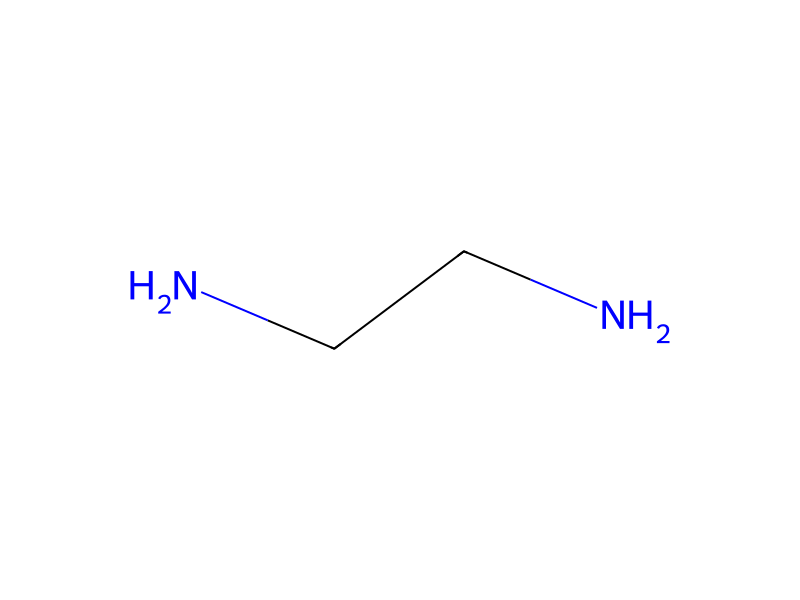



Product 1

Reagents, catalysts & solvents 2


Procedure
In a manner analogous to that described in Example 7, 11.8 g (0.08 mol) of 4-cyanobenzoic acid are reacted with triethylamine and ethyl chloroformate and worked-up and then added dropwise to a solution of 21.4 ml of ethylenediamine in 350 ml of chloroform. After adding 45 ml of dimethylformamide, the mixture is heated to 60° for a further 1 hour. After filtration, the filtrate is concentrated, and the residue is treated in the same manner as described in Example 7. There are obtained 3.5 g of N-(2-aminoethyl)-4-cyanobenzamide hydrochloride, m.p. 212°-215° (decomposition). The free base melts at 124°-126°.
Workup
- temperaturethe mixture is heated to 60° for a further 1 hour
- filtrationAfter filtration
- concentrationthe filtrate is concentrated
- additionthe residue is treated in the same manner
Sources & evidence
- ORD record
- ord-4ef60d22ac554724b6f1a0436e6c3679
- Source dataset
- uspto-grants-1993_08
- Patent number
- US05238962
Reaction notes
Loading…