Triethylamine → 4-Formyl-2-pent-1-ynyl-benzoic acid methyl ester
Reaction equation

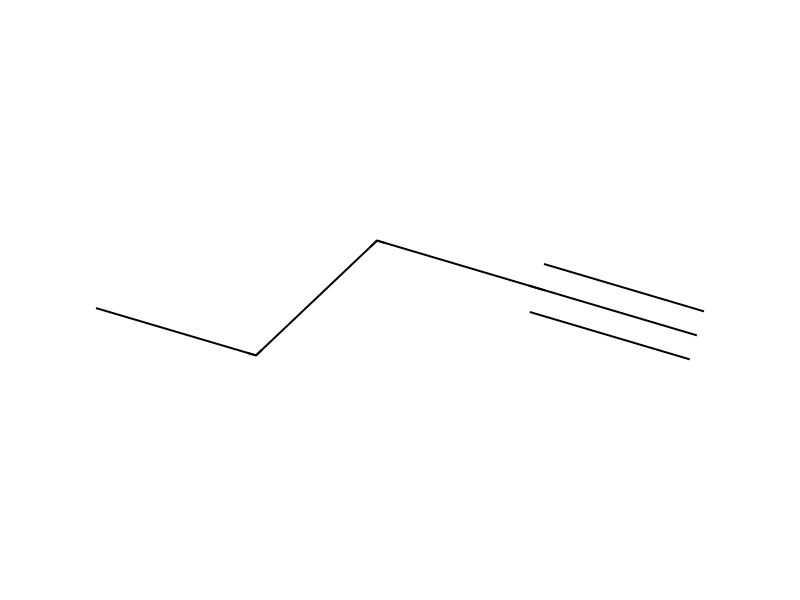
[CH3:1][O:2][C:3](=[O:13])[C:4]1[CH:9]=[CH:8][C:7]([CH:10]=[O:11])=[CH:6][C:5]=1Br.C(N(CC)CC)C.[CH:21]#[C:22][CH2:23][CH2:24][CH3:25]>CN(C=O)C.Cl[Pd](Cl)([P](C1C=CC=CC=1)(C1C=CC=CC=1)C1C=CC=CC=1)[P](C1C=CC=CC=1)(C1C=CC=CC=1)C1C=CC=CC=1.[Cu]I>[CH3:1][O:2][C:3](=[O:13])[C:4]1[CH:9]=[CH:8][C:7]([CH:10]=[O:11])=[CH:6][C:5]=1[C:21]#[C:22][CH2:23][CH2:24][CH3:25]Participants
7
Reactant 3


Product 1

Reagents, catalysts & solvents 3



Conditions
- Temperature
- 80 °C
Procedure
To a room temperature solution of 2-Bromo-4-formyl-benzoic acid methyl ester (500 mg, 2.05 mmol) in degassed DMF (5 mL) are added triethylamine (2.0 mL, 14.35 mmol), dichlorobis(triphenylphosphine)palladium (II) (144 mg, 0.205 mmol, 10 mol %), copper (I) iodide (20 mg, 0.103 mmol, 5 mol %), and 1-Pentyne (406 μL, 4.10 mmol). The reaction mixture is heated to 80° C. in a sealed tube. After 2 h, the reaction is concentrated and the residue is chromatographed (0% to 10% EtOAc/Hex) to yield the title compound (279 mg, 59%). 1H NMR (400 MHz, CDCl3) δ 10.03 (s, 1H), 8.02-7.98 (m, 2H), 7.80 (dd, 1H, J=7.9, 1.8 Hz), 3.95 (s, 3H), 2.48 (t, 2H, J=7.0 Hz), 1.73-1.63 (m, 2H), 1.09 (t, 3H, J=7.5 Hz).
Workup
- concentrationthe reaction is concentrated
- customthe residue is chromatographed (0% to 10% EtOAc/Hex)
Sources & evidence
- ORD record
- ord-fa11856bd5484b349d5ffa4a655ef336
- Source dataset
- uspto-grants-2010_12
- Patent number
- US07846960B2
Reaction notes
Loading…