Hydrochloric Acid → HCID 57418651, compound
Reaction equation

[C:1]([CH2:3][N:4]([C:11]1[CH:16]=[CH:15][C:14]([Cl:17])=[C:13]([Cl:18])[CH:12]=1)[CH2:5][C:6]([O:8]CC)=[O:7])#[N:2].[Li+].[OH-].FC(F)(F)C(O)=O.Cl.O1CCOCC1>C1COCC1.O.CC#N.O>[C:1]([CH2:3][N:4]([C:11]1[CH:16]=[CH:15][C:14]([Cl:17])=[C:13]([Cl:18])[CH:12]=1)[CH2:5][C:6]([OH:8])=[O:7])#[N:2]Participants
Reactant 5





Product 1

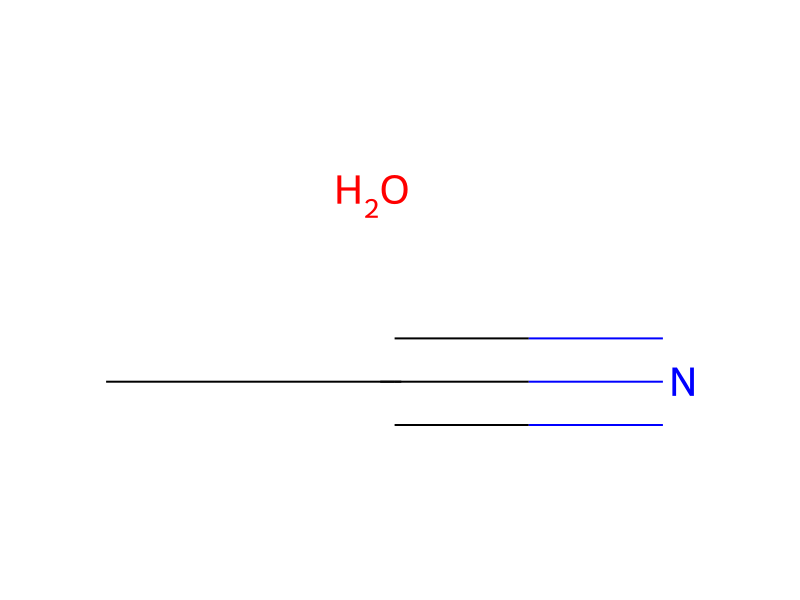
Reagents, catalysts & solvents 3


Procedure
Ethyl N-(cyanomethyl)-N-(3,4-dichlorophenyl)glycinate (1.00 g, 3.48 mmol) was dissolved in 10 mL of THF and treated with LiOH (83.4 mg, 3.48 mmol) dissolved in 2 mL of water. After 2 h, HPLC (Eclipse XDB-C18, 4.6×250 mm, 5 micron, 1-99% CH3CN/H2O with 0.1% trifluoroacetic acid) showed that all of the starting material (Rt=7.6 min) was gone and that a single new peak (Rt=6.2 min) had formed. The reaction mixture was treated with a solution of 4.0M HCl in dioxane (1.74 mL, 6.96 mmol) and then the solvent was removed by rotary evaporation followed by high vacuum to give 870 mg (3.36 mmol, 96%) of N-(cyanomethyl)-N-(3,4-dichlorophenyl)glycine as a white solid which was used in subsequent chemistry without further purification. LC/MS (APCI) m/e 232 [M−CN]+.
Workup
- customhad formed
- customthe solvent was removed by rotary evaporation
Sources & evidence
- ORD record
- ord-ca2424e554184a19ae7fce9a72902934
- Source dataset
- uspto-grants-2010_07
- Patent number
- US07749998B2
Reaction notes
Loading…