Sodium hydride → HCID 67044267, compound
Reaction equation

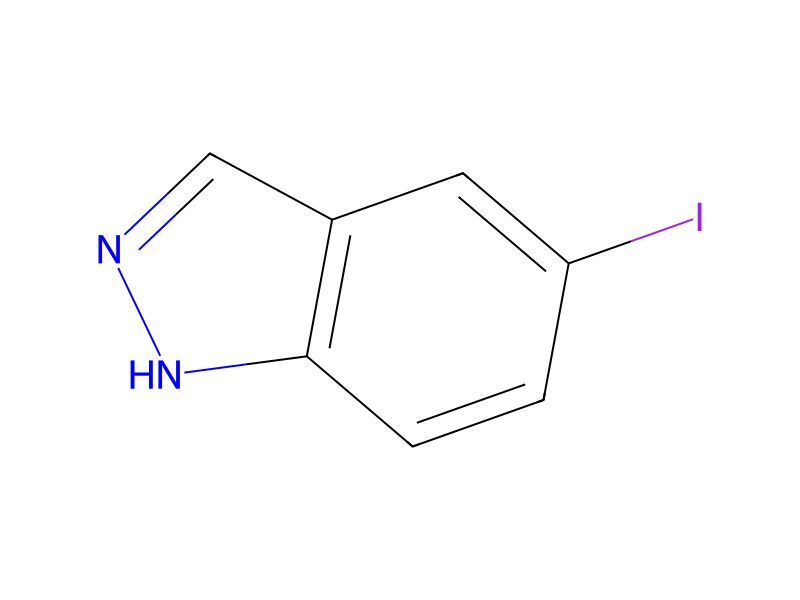
[H-].[Na+].[I:3][C:4]1[CH:5]=[C:6]2[C:10](=[CH:11][CH:12]=1)[NH:9][N:8]=[CH:7]2.[CH:13]([Si:16](Cl)([CH:20]([CH3:22])[CH3:21])[CH:17]([CH3:19])[CH3:18])([CH3:15])[CH3:14]>CN(C)C=O.C(OCC)(=O)C.O>[I:3][C:4]1[CH:5]=[C:6]2[C:10](=[CH:11][CH:12]=1)[N:9]([Si:16]([CH:20]([CH3:22])[CH3:21])([CH:17]([CH3:19])[CH3:18])[CH:13]([CH3:15])[CH3:14])[N:8]=[CH:7]2Participants






Procedure
To a slurry of sodium hydride (0.67 g, 17 mmol) in N,N-dimethylformamide (43 mL) cooled to 0° C. was added 5-iodo-1H-indazole (3.1 g, 13 mmol). After stirring for 15 min, triisopropylsilyl chloride (3.4 mL, 17 mmol) was added dropwise and the solution was allowed to warm to room temperature. The solution was diluted with ethyl acetate and water and the layers were separated. The aqueous layer was extracted (2×100 mL ethyl acetate) and the combined organic layers were dried (sodium sulfate), filtered and concentrated in vacuo. Column chromatography (silica gel, 20:1 hexanes/ethyl acetate) gave 1.8 g (68%) of 5-iodo-1-[tris(1-methylethyl)silyl]-1H-indazole as a yellow solid. 1H NMR (400 MHz, CDCl3): 8.14 (d, 1H), 8.11 (d, 1H), 7.55 (dd, 1H), 7.35 (d, 1H), 1.77 (m, 3H), 1.10 (m, 18H).
Workup
- customthe layers were separated
- extractionThe aqueous layer was extracted (2×100 mL ethyl acetate)
- dry with materialthe combined organic layers were dried (sodium sulfate)
- filtrationfiltered
- concentrationconcentrated in vacuo
Sources & evidence
- ORD record
- ord-f8f87ea4cea64f9aab8257680d23207d
- Source dataset
- uspto-grants-2014_04
- Patent number
- US08697737B2
Reaction notes
Loading…