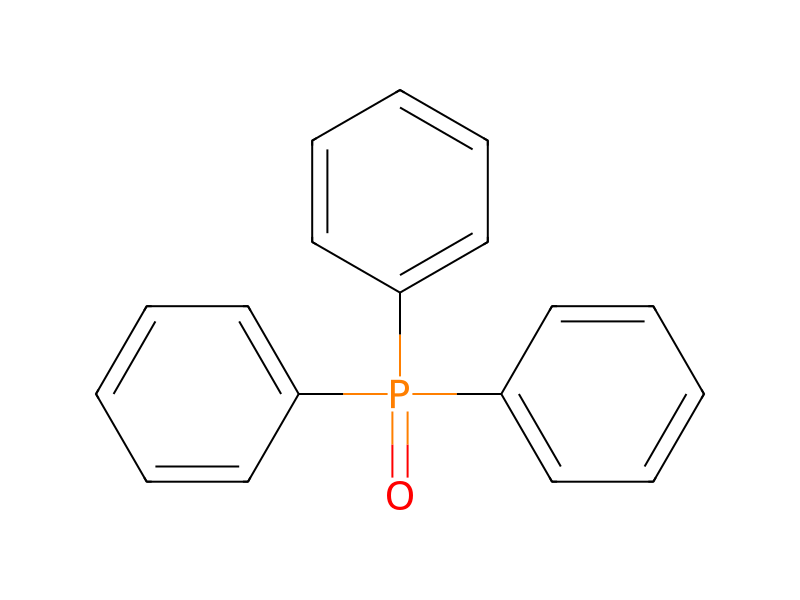
Triphenylphosphine → HCID 59632996, compound
Reaction equation

[Cl:1][C:2]1[CH:7]=[CH:6][CH:5]=[CH:4][C:3]=1[N:8]1[C:12]([C:13]2[CH:14]=[C:15]([OH:19])[CH:16]=[CH:17][CH:18]=2)=[CH:11][C:10]([C:20]([F:23])([F:22])[F:21])=[N:9]1.C1(P(C2C=CC=CC=2)C2C=CC=CC=2)C=CC=CC=1.[O:43]1[CH2:48][CH2:47][N:46]([CH2:49][CH2:50]O)[CH2:45][CH2:44]1.CC(OC(/N=N/C(OC(C)C)=O)=O)C.C1(P(=O)(C2C=CC=CC=2)C2C=CC=CC=2)C=CC=CC=1>C1COCC1>[Cl:1][C:2]1[CH:7]=[CH:6][CH:5]=[CH:4][C:3]=1[N:8]1[C:12]([C:13]2[CH:14]=[C:15]([CH:16]=[CH:17][CH:18]=2)[O:19][CH2:50][CH2:49][N:46]2[CH2:47][CH2:48][O:43][CH2:44][CH2:45]2)=[CH:11][C:10]([C:20]([F:23])([F:21])[F:22])=[N:9]1Participants






Procedure
To a solution of 3-(1-(2-chlorophenyl)-3-(trifluoromethyl)-1H-pyrazol-5-yl)phenol (155 mg, 0.5 mmol) and triphenylphosphine (170 mg, 0.65 mmol) in THF (2 mL) was added 2-morpholinoethanol (72 μL, 0.59 mmol). The solution was cooled in an ice bath and treated with diisopropylazodicarboxylate (125 μL, 0.64 mmol). After a few minutes the ice bath was removed and the reaction was allowed to stir while warming to ambient temperature. After stirring for 16 hours LC/MS analysis showed desired product and triphenylphosphine oxide as the major peaks. The reaction solution was concentrated under reduced pressure and the resulting yellow oil was purified by flash column chromatography eluting with 30% followed by 40% EtOAc/hexane, and then a gradient of CH2Cl2 to 4% MeOH/CH2Cl2. The white solid that was obtained was found to be contaminated with triphenylphosphine oxide. This crude product was further purified by normal phase preparative HPLC eluting with a gradient from CH2Cl2 to 10% isopropanol/CH2Cl2 to afford 4-(2-(3-(1-(2-chlorophenyl)-3-(trifluoromethyl)-1H-pyrazol-5-yl)phenoxy)ethyl)morpholine (139 mg, 67% yield) as a thick syrup. MS(ES): 452 [M+H]+.
Workup
- temperatureThe solution was cooled in an ice bath
- customAfter a few minutes the ice bath was removed
- stirringAfter stirring for 16 hours LC/MS analysis
- concentrationThe reaction solution was concentrated under reduced pressure
- customthe resulting yellow oil was purified by flash column chromatography
- washeluting with 30%
- customThe white solid that was obtained
- customThis crude product was further purified by normal phase preparative HPLC
- washeluting with a gradient from CH2Cl2 to 10% isopropanol/CH2Cl2
Sources & evidence
- ORD record
- ord-aa736e5500ce47fca22289348f321617
- Source dataset
- uspto-grants-2014_04
- Patent number
- US08703805B2
Reaction notes
Loading…