Piperazine → HCID 64369269, compound
Reaction equation

[NH:1]1[CH2:6][CH2:5][NH:4][CH2:3][CH2:2]1.Cl[C:8]1[C:13]([N+:14]([O-:16])=[O:15])=[CH:12][CH:11]=[C:10]([Cl:17])[N:9]=1.C(N(C(C)C)CC)(C)C.C(=O)(O)[O-].[Na+]>ClCCl>[Cl:17][C:10]1[N:9]=[C:8]([N:1]2[CH2:6][CH2:5][NH:4][CH2:3][CH2:2]2)[C:13]([N+:14]([O-:16])=[O:15])=[CH:12][CH:11]=1Participants
6
Reactant 4


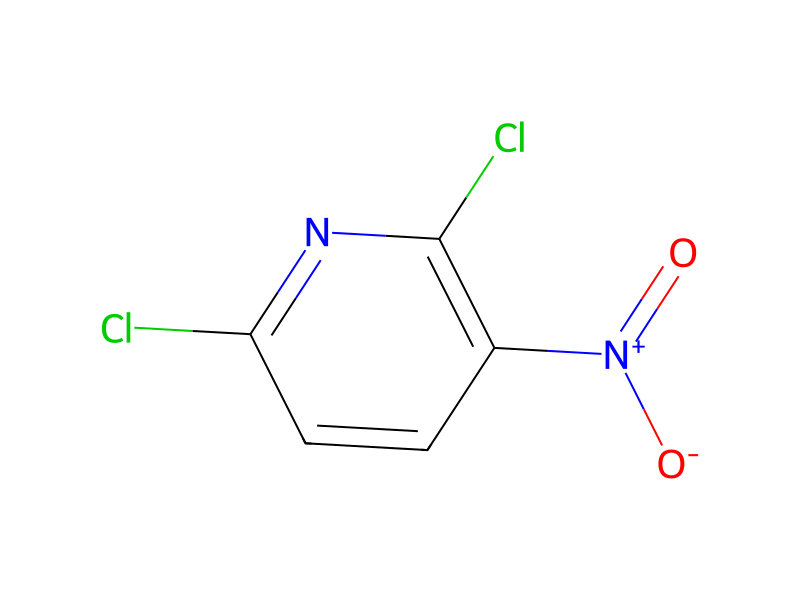

Product 1

Reagents, catalysts & solvents 1

Procedure
piperazine (1.38 g) was added to a stirred solution of 2,6-dichloro-3-nitropyridine (3.0 g, prepared according to J. Heterocyclic Chem. 1994, 31, 73) and diisopropylethylamine (3.0 ml) in dichloromethane (100 ml) at 0° C. under N2. The resulting solution was stirred at room temperature for 2 hours then poured into saturated aqueous sodium bicarbonate, extracted with dichloromethane, dried over sodium sulfate and concentrated in vacuo. The residue was subjected to silica gel chromatography (ethyl acetate:methanol 8:2) to afford 1-(6-Chloro-3-nitro-pyridin-2-yl)-piperazine (2.99 g) as a red solid. M.p. 50-53° C.; MS (ES+) 243/245 (M+H+).
Workup
- extractionextracted with dichloromethane
- dry with materialdried over sodium sulfate
- concentrationconcentrated in vacuo
Sources & evidence
- ORD record
- ord-5d0b96cf0dab4d64b10478f3e7f8400b
- Source dataset
- uspto-grants-2014_08
- Patent number
- US08796274B2
Reaction notes
Loading…