Dimethylformamide → Methyl 2-chloro-4-cyanobenzoate
Reaction equation

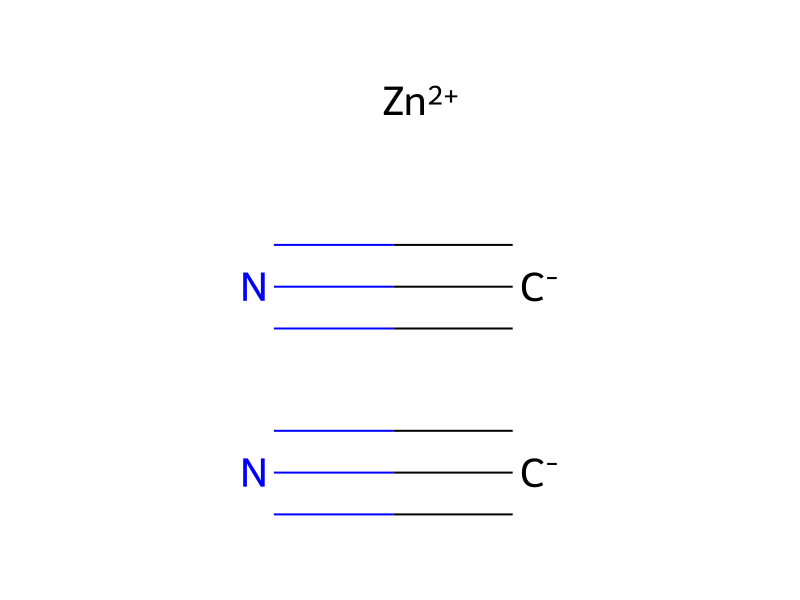
C1(P(C2C=CC=CC=2)C2C=CC=CC=2)C=CC=CC=1.Br[C:21]1[CH:30]=[CH:29][C:24]([C:25]([O:27][CH3:28])=[O:26])=[C:23]([Cl:31])[CH:22]=1.[CH3:32][N:33](C=O)C>C([O-])(=O)C.[Pd+2].C([O-])(=O)C.[C-]#N.[Zn+2].[C-]#N>[Cl:31][C:23]1[CH:22]=[C:21]([C:32]#[N:33])[CH:30]=[CH:29][C:24]=1[C:25]([O:27][CH3:28])=[O:26]Participants





Procedure
A mixture of triphenylphosphine polymer bound (239 mg, 0.72 mmol) and palladium(II) acetate (75 mg, 0.33 mmol) was prepared in DMF (12 mL) under nitrogen atmosphere and stirred at RT for 2 hours. Zinc cyanide (561 mg, 4.77 mmol) and methyl 4-bromo-2-chlorobenzoate (1.19 g, 4.77 mmol) were added and the resulting mixture was heated under microwave irradiation at 140° C. for 50 minutes. The reaction mixture was filtered and the resin was washed with Et2O (3×10 mL). The combined organic layers were washed with water (3×5 mL) and brine (10 mL), dried (MgSO4) and concentrated under vacuum to give the title compound as a white powder. 1H NMR (DMSO-d6, 300 MHz) δ 8.23 (m, 1H), 7.96 (m, 2H), 3.90 (s, 3H). HPLC (Method A) Rt 3.39 min (Purity: 97.6%).
Workup
- temperaturethe resulting mixture was heated under microwave irradiation at 140° C. for 50 minutes
- filtrationThe reaction mixture was filtered
- washthe resin was washed with Et2O (3×10 mL)
- washThe combined organic layers were washed with water (3×5 mL) and brine (10 mL)
- dry with materialdried (MgSO4)
- concentrationconcentrated under vacuum
Sources & evidence
- ORD record
- ord-6cfbda45fb6341f299433bdb1444298e
- Source dataset
- uspto-grants-2014_08
- Patent number
- US08802704B2
Reaction notes
Loading…