Sodium Carbonate → 4'-(Trifluoromethyl)-4-biphenylcarbaldehyde
Reaction equation

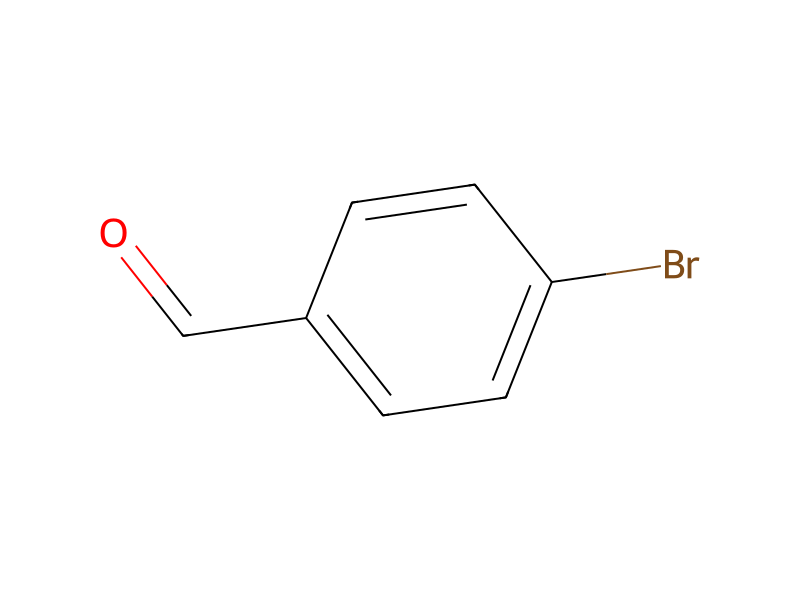
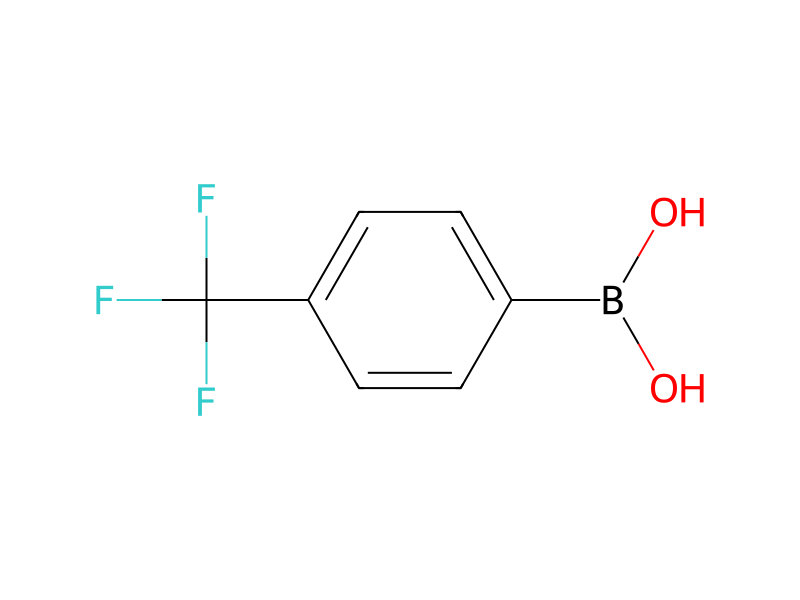
Br[C:2]1[CH:9]=[CH:8][C:5]([CH:6]=[O:7])=[CH:4][CH:3]=1.[F:10][C:11]([F:22])([F:21])[C:12]1[CH:17]=[CH:16][C:15](B(O)O)=[CH:14][CH:13]=1.C1(P(C2C=CC=CC=2)C2C=CC=CC=2)C=CC=CC=1.C(=O)([O-])[O-].[Na+].[Na+]>C([O-])(=O)C.[Pd+2].C([O-])(=O)C.O.C(O)CC>[F:10][C:11]([F:22])([F:21])[C:12]1[CH:17]=[CH:16][C:15]([C:2]2[CH:9]=[CH:8][C:5]([CH:6]=[O:7])=[CH:4][CH:3]=2)=[CH:14][CH:13]=1Participants
Reactant 4


Product 1

Reagents, catalysts & solvents 3



Conditions
- Temperature
- 70 °C
Procedure
A round bottom flask was charged with 4-bromobenzaldehyde (69.6 g, 376 mmol), 4-(trifluoromethyl)phenylboronic acid (75.0 g, 395 mmol) and 1-propanol (627 mL). The reaction mixture was stirred for 15 minutes at 70° C. until a clear solution was obtained. The resulting solution was treated with triphenylphosphine (888 mg, 3.38 mmol), palladium(II) acetate (256 mg, 1.13 mmol), 2M sodium carbonate (226 mL, 451 mmol) and water (138 mL). The reaction was heated at reflux for 1 hour, open to air. Water (900 mL) was then added and the reaction was cooled to 7° C. in an ice bath. The reaction was thoroughly stirred for 30 minutes until the title compound precipitated out. The mixture was then filtered and the solid washed with cold water (˜600 mL). The solid was then solubilized in diethylether (500 mL) and filtered through a pad of celite and silica, rinsing with diethylether (2×500 mL). Removal of the solvent under reduced pressure afforded 4′-(trifluoromethyl) biphenyl-4-carbaldehyde (90.0 g, 96%) as a pure white solid. 1H NMR (400 MHz, CDCl3, δ): 7.75 (s, 4 H) 7.76-7.79 (m, 2 H) 7.96-8.04 (m, 2 H) 10.10 (s, 1 H). MS (M+1): 250.3.
Workup
- customwas obtained
- temperatureThe reaction was heated
- temperatureat reflux for 1 hour, open to air
- temperaturethe reaction was cooled to 7° C. in an ice bath
Sources & evidence
- ORD record
- ord-f323582e6556484f852b6c43e9fce55b
- Source dataset
- uspto-grants-2014_08
- Patent number
- US08809342B2
Reaction notes
Loading…