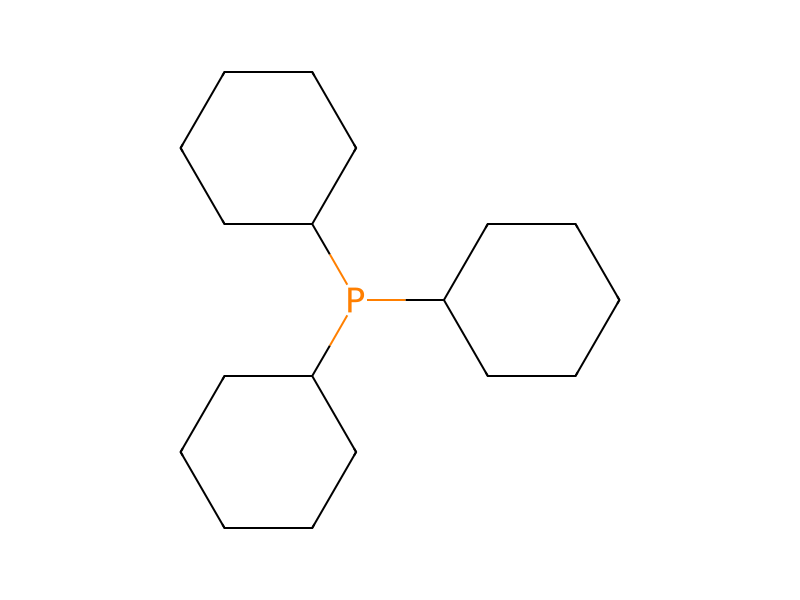
Tricyclohexylphosphine → 7-bromo-4-(3-methylphenyl)-2H-chromen-2-one
Reaction equation

FC(F)(F)S(O[C:7]1[C:16]2[C:11](=[CH:12][C:13]([Br:17])=[CH:14][CH:15]=2)[O:10][C:9](=[O:18])[CH:8]=1)(=O)=O.[CH3:21][C:22]1[CH:23]=[C:24](B(O)O)[CH:25]=[CH:26][CH:27]=1.C1(P(C2CCCCC2)C2CCCCC2)CCCCC1.[F-].[K+]>C1COCC1.C([O-])(=O)C.[Pd+2].C([O-])(=O)C>[Br:17][C:13]1[CH:12]=[C:11]2[C:16]([C:7]([C:26]3[CH:25]=[CH:24][CH:23]=[C:22]([CH3:21])[CH:27]=3)=[CH:8][C:9](=[O:18])[O:10]2)=[CH:15][CH:14]=1Participants
Reactant 4



Product 1

Reagents, catalysts & solvents 2


Procedure
To a solution of 7-bromo-2-oxo-2H-chromen-4-yl trifluoromethanesulfonate (prepared as described in U.S. Pat. No. 5,552,437) (1.1 g, 3.0 mmol) and 3-methylbenzeneboronic acid (450 mg, 3.3 mmol) in THF (12 mL), tricyclohexylphosphine (30 mg, 0.1 mmol) and potassium fluoride (574 mg, 9.9 mmol) were added. The reaction mixture was purged twice with nitrogen before palladium (II) acetate (20 mg, 0.1 mmol) was added. After 16 hours stirring at room temperature the reaction mixture was filtered over celite and the filtrate was concentrated under reduced pressure. The crude residue obtained was purified by column chromatography (CH2Cl2/hexanes, 70:30). To afford the title compound 1H NMR (400 MHz, acetone-d6): 7.67 (s, 1H), 7.53-7.33 (m, 6H), 6.40 (s, 1H), 2.46 (s, 3H).
Workup
- additionwas added
- filtrationwas filtered over celite
- concentrationthe filtrate was concentrated under reduced pressure
- customThe crude residue obtained
- customwas purified by column chromatography (CH2Cl2/hexanes, 70:30)
Sources & evidence
- ORD record
- ord-894a9d155a3c489e8dbb2b9af34761dc
- Source dataset
- uspto-grants-2011_06
- Patent number
- US07960409B2
Reaction notes
Loading…