4-Bromophenol → Tert-butyl 3-(4-bromophenoxy)azetidine-1-carboxylate
Reaction equation

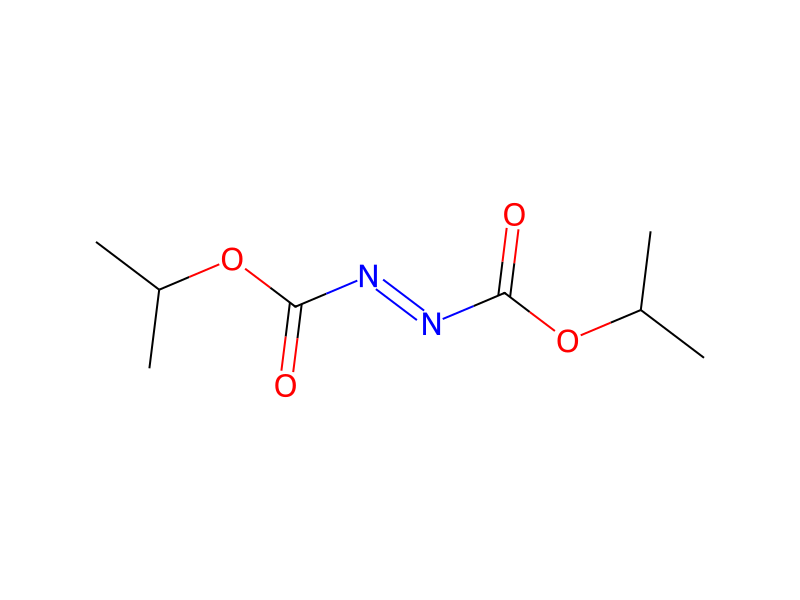
[OH:1][CH:2]1[CH2:5][N:4]([C:6]([O:8][C:9]([CH3:12])([CH3:11])[CH3:10])=[O:7])[CH2:3]1.[Br:13][C:14]1[CH:19]=[CH:18][C:17](O)=[CH:16][CH:15]=1.C1(P(C2C=CC=CC=2)C2C=CC=CC=2)C=CC=CC=1.CC(OC(/N=N/C(OC(C)C)=O)=O)C>C1COCC1>[Br:13][C:14]1[CH:19]=[CH:18][C:17]([O:1][CH:2]2[CH2:3][N:4]([C:6]([O:8][C:9]([CH3:12])([CH3:11])[CH3:10])=[O:7])[CH2:5]2)=[CH:16][CH:15]=1Participants
6
Reactant 4



Product 1

Reagents, catalysts & solvents 1

Conditions
- Temperature
- 110 °C
Procedure
A mixture of tert-butyl 3-hydroxyazetidine-1-carboxylate (200 mg, 1.15 mmol), 4-bromophenol (240 mg, 1.39 mmol), triphenylphosphine (398 mg, 1.50 mmol) and DIAD (202 mg, 1.39 mmol) in anhydrous THF (5 mL) was heated to 110° C. and stirred under nitrogen for 5 hours. The reaction mixture was concentrated in vacuo to give a brown residue, which was purified by flash chromatography (petroleum ether/ethyl acetate 10:1 to 4:1) to give tert-butyl 3-(4-bromophenoxy)azetidine-1-carboxylate (300 mg, 79.5%) as a white solid.
Workup
- concentrationThe reaction mixture was concentrated in vacuo
- customto give a brown residue, which
- customwas purified by flash chromatography (petroleum ether/ethyl acetate 10:1 to 4:1)
Sources & evidence
- ORD record
- ord-be33052dc9b44b19bd75d35996f1438c
- Source dataset
- uspto-grants-2014_11
- Patent number
- US08889730B2
Reaction notes
Loading…