4-Hydroxybenzaldehyde → 4-(3,3,3-Trifluoropropoxy)benzaldehyde
Reaction equation

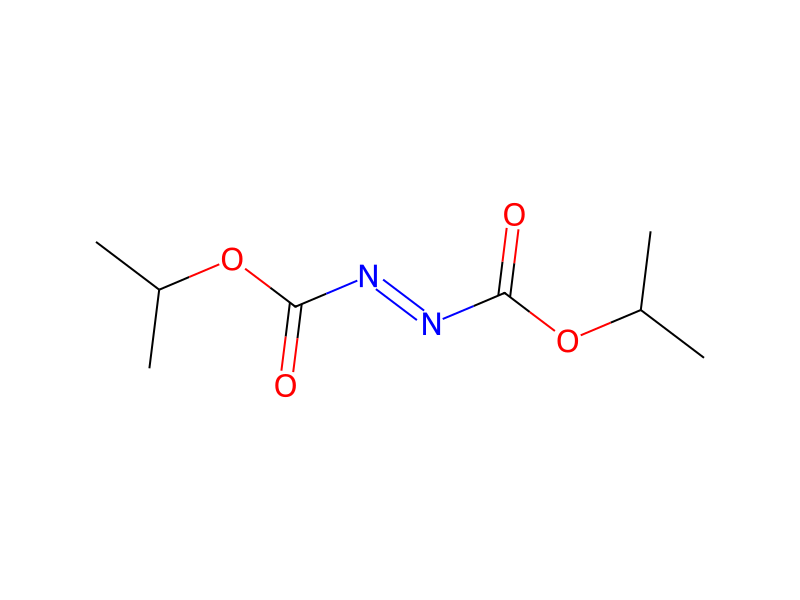
[OH:1][C:2]1[CH:9]=[CH:8][C:5]([CH:6]=[O:7])=[CH:4][CH:3]=1.[F:10][C:11]([F:16])([F:15])[CH2:12][CH2:13]O.C1(P(C2C=CC=CC=2)C2C=CC=CC=2)C=CC=CC=1.CC(OC(/N=N/C(OC(C)C)=O)=O)C>C1COCC1>[F:10][C:11]([F:16])([F:15])[CH2:12][CH2:13][O:1][C:2]1[CH:9]=[CH:8][C:5]([CH:6]=[O:7])=[CH:4][CH:3]=1Participants
6





Procedure
To a stirred solution of 4-hydroxybenzaldehyde (0.36 g, 2.93 mmol), 3,3,3-trifluoropropanol (0.5 g, 4.39 mmol) and triphenylphosphine (1.15 g, 4.39 mmol) in dry THF (10 ml) at 0° C. under an atmosphere of argon was added dropwise diisopropylazodicarboxylate (0.89 g, 4.39 mmol). On completion of the addition, the reaction mixture was stirred at room temperature for 60 h. The solvent was removed under reduced pressure and the residue was purified by flash chromatography (4:1 Hexane/EtOAc) to give the title compound (0.25 g, 46%) as a colourless solid.
Workup
- additionOn completion of the addition
- customThe solvent was removed under reduced pressure
- customthe residue was purified by flash chromatography (4:1 Hexane/EtOAc)
Sources & evidence
- ORD record
- ord-30640eb58511495b83faa2a0fcf20d35
- Source dataset
- uspto-grants-2014_11
- Patent number
- US08895313B2
Reaction notes
Loading…