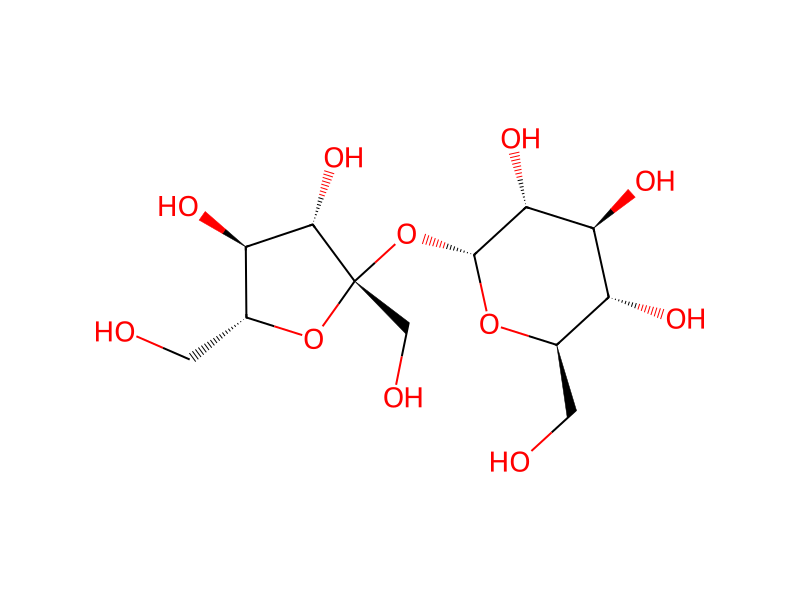
Sucrose → HCID 71752857, compound
Reaction equation

[CH2:1]([OH:23])[C@H:2]1[O:7][C@H:6]([O:8][C@:9]2([CH2:18][OH:19])[O:13][C@H:12]([CH2:14][OH:15])[C@@H:11]([OH:16])[C@@H:10]2[OH:17])[C@H:5]([OH:20])[C@@H:4]([OH:21])[C@@H:3]1[OH:22].C(N([CH2:29][CH3:30])CC)C.[C:31](Cl)([C:44]1[CH:49]=[CH:48][CH:47]=[CH:46][CH:45]=1)([C:38]1[CH:43]=[CH:42][CH:41]=[CH:40][CH:39]=1)[C:32]1[CH:37]=[CH:36][CH:35]=[CH:34][CH:33]=1.C(Cl)Cl>CN(C)C=O>[CH:35]1[CH:36]=[CH:37][C:32]([C:31]([O:23][CH2:1][C@H:2]2[O:7][CH:6]([O:8][C@:9]3([CH2:18][O:19][C:31]([C:30]4[CH:29]=[CH:49][CH:44]=[CH:45][CH:46]=4)([C:32]4[CH:37]=[CH:36][CH:35]=[CH:34][CH:33]=4)[C:38]4[CH:43]=[CH:42][CH:41]=[CH:40][CH:39]=4)[O:13][C@H:12]([CH2:14][O:15][C:31]([C:38]4[CH:39]=[CH:40][CH:41]=[CH:42][CH:43]=4)([C:32]4[CH:33]=[CH:34][CH:35]=[CH:36][CH:37]=4)[C:44]4[CH:49]=[CH:48][CH:47]=[CH:46][CH:45]=4)[C@@H:11]([OH:16])[C@@H:10]3[OH:17])[C@H:5]([OH:20])[C@@H:4]([OH:21])[C@H:3]2[OH:22])([C:44]2[CH:49]=[CH:48][CH:47]=[CH:46][CH:45]=2)[C:38]2[CH:43]=[CH:42][CH:41]=[CH:40][CH:39]=2)=[CH:33][CH:34]=1Participants
Reactant 4



Product 1

Reagents, catalysts & solvents 1

Conditions
- Temperature
- 50 °C
Procedure
In a dry 5-L four-neck flask is dissolved 70 grams of sucrose (204.5 mmol) in 1 liter dry dimethylformamide (DMF) and dry triethylamine (200 ml, 145 grams, 1,423 mmol). The solution is allowed to attain a temperature of 25° to 30° C. and treated with a solution of trityl chloride (260 grams, 935.2 mmol, 4.5 equiv.) in dimethylformamide (600 ml), added dropwise over 1 hour. After the addition is complete, the reaction mixture is heated to a temperature of 50° C. and allowed to stir for 48 hours at that temperature. After 2 days, the reaction mixture is filtered through a short pad of silica gel to remove the precipitated triethylammonium hydrochloride and the residue is washed with methylene chloride:acetone (4:1). The effluent is then concentrated to a residue, which is reconstituted in methylene chloride and washed successively with 1N hydrochloric acid, saturated sodium bicarbonate solution, water, and brine and then dried over anhydrous sodium sulfate. The dry organic extract is then filtered and concentrated in vacuo to provide a yellow foamy solid. This material is then applied on a silica gel column (230 to 400 mesh, 10 cm×50 cm) packed with methylene chloride and successively eluted with methylene chloride, then 10% acetone in methylene chloride, followed by elution with 20% acetone in methylene chloride. The desired tri-O-tritylsucrose elutes with 20% acetone in methylene chloride and has an Rf of 0.21 in the same solvent. The amount of 1',6,6'-tri-O-tritylsucrose obtained by this method of synthesis and isolation is typically between 146 to 150 grams or 67% to 68.8%. On scales between 1 mmol and 50 mmol (314 mg to 15.7 grams) yields average about 76%.
Workup
- customa temperature of 25° to 30° C.
- additionadded dropwise over 1 hour
- additionAfter the addition
- waitAfter 2 days
- filtrationthe reaction mixture is filtered through a short pad of silica gel
- customto remove the precipitated triethylammonium hydrochloride
- washthe residue is washed with methylene chloride:acetone (4:1)
- concentrationThe effluent is then concentrated to a residue, which
- washwashed successively with 1N hydrochloric acid, saturated sodium bicarbonate solution, water, and brine
- dry with materialdried over anhydrous sodium sulfate
- extractionThe dry organic extract
- filtrationis then filtered
- concentrationconcentrated in vacuo
- customto provide a yellow foamy solid
- washsuccessively eluted with methylene chloride
- wash10% acetone in methylene chloride, followed by elution with 20% acetone in methylene chloride
Sources & evidence
- ORD record
- ord-f99c26e736384db59d2002e8b14234ee
- Source dataset
- uspto-grants-1992_11
- Patent number
- US05166334
Reaction notes
Loading…