Thiazole → HCID 10774002, compound
Reaction equation

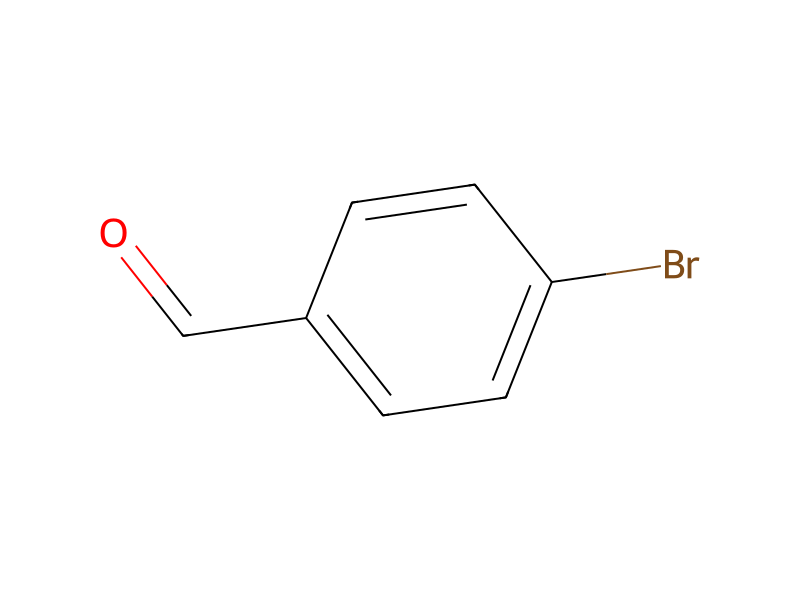
Br[C:2]1[CH:9]=[CH:8][C:5]([CH:6]=[O:7])=[CH:4][CH:3]=1.[S:10]1[CH:14]=[CH:13][N:12]=[CH:11]1.C([O-])(=O)C.[K+]>CC(N(C)C)=O.C1C=CC([P]([Pd]([P](C2C=CC=CC=2)(C2C=CC=CC=2)C2C=CC=CC=2)([P](C2C=CC=CC=2)(C2C=CC=CC=2)C2C=CC=CC=2)[P](C2C=CC=CC=2)(C2C=CC=CC=2)C2C=CC=CC=2)(C2C=CC=CC=2)C2C=CC=CC=2)=CC=1>[S:10]1[C:14]([C:2]2[CH:9]=[CH:8][C:5]([CH:6]=[O:7])=[CH:4][CH:3]=2)=[CH:13][N:12]=[CH:11]1Participants
Reactant 3


Product 1

Reagents, catalysts & solvents 2


Conditions
- Temperature
- 150 °C
Procedure
In a bomb tube, a mixture of 3.7 g (20 mmol) of 4-bromobenzaldehyde (Fluka, Buchs, Switzerland), 6.64 ml (93 mmol) of thiazole, 2.94 g of potassium acetate and 1.16 g (1 mmol) of Pd(PPh3)4 in 50 ml of dimethylacetamide is stirred at 150° C. for 12 hours. The reaction mixture is concentrated by evaporation. Water is added to the residue and the mixture is extracted 3× with methylene chloride. The organic phases are filtered through cotton wadding, concentrated by evaporation and chromatographed (SiO2; hexane/ethyl acetate 1:2), yielding the title compound: HPLC20-100: tRet=11.4; 1H-NMR (CD3OD) δ 9.98 (s, HCO), 9.03 (s, H(2)thiazole), 8.32 (s, H(4)thiazole), 7.95 and 7.85 (2d, J=8, each 2H); additionally also signals of the hydrate (≈12%): 8.92 (s, H(2)thiazole), 8.15 (s, H(4)thiazole), 7.62 and 7.53 (2d, J=8, each 2H), 5.54 (s, HC(OH)2).
Workup
- concentrationThe reaction mixture is concentrated by evaporation
- additionWater is added to the residue
- extractionthe mixture is extracted 3× with methylene chloride
- filtrationThe organic phases are filtered through cotton wadding
- concentrationconcentrated by evaporation
- customchromatographed (SiO2; hexane/ethyl acetate 1:2)
Sources & evidence
- ORD record
- ord-6c66efc21b464eefbff77d5fae6e399b
- Source dataset
- uspto-grants-2001_10
- Patent number
- US06300519B1
Reaction notes
Loading…