Triphenylphosphine → (3,5-Dimethyl-phenylethynyl)-trimethyl-silane
Reaction equation

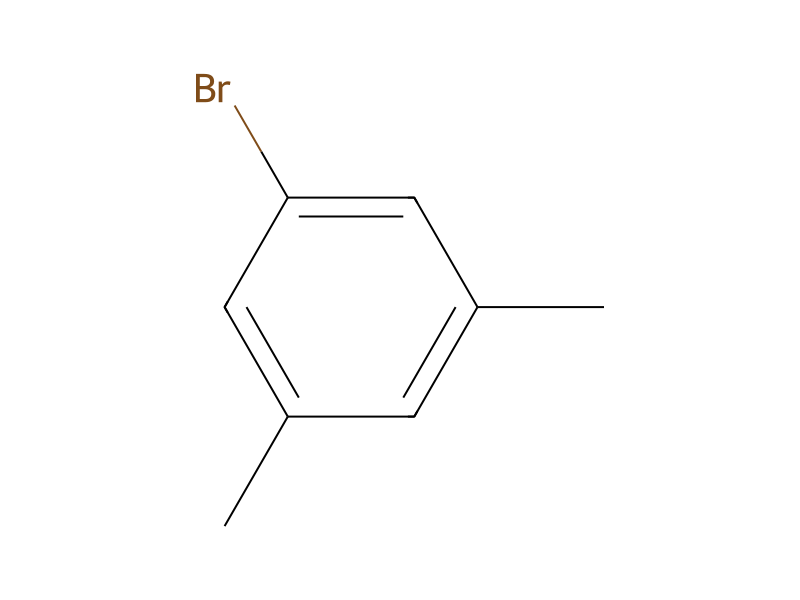
Br[C:2]1[CH:3]=[C:4]([CH3:9])[CH:5]=[C:6]([CH3:8])[CH:7]=1.C1C=CC(P(C2C=CC=CC=2)C2C=CC=CC=2)=CC=1.[CH3:29][Si:30]([C:33]#[CH:34])([CH3:32])[CH3:31]>[Cu]I.Cl[Pd](Cl)([P](C1C=CC=CC=1)(C1C=CC=CC=1)C1C=CC=CC=1)[P](C1C=CC=CC=1)(C1C=CC=CC=1)C1C=CC=CC=1.C(NC(C)C)(C)C>[CH3:29][Si:30]([CH3:32])([CH3:31])[C:33]#[C:34][C:2]1[CH:3]=[C:4]([CH3:9])[CH:5]=[C:6]([CH3:8])[CH:7]=1Participants
Reactant 3


Product 1

Reagents, catalysts & solvents 3



Conditions
- Temperature
- 75 °C
Procedure
A solution of 5-bromo-m-xylene (19.4 g, 105 mmol) and diisopropylamine (100 mL) was degassed with argon and kept under an argon atmosphere. CuI (2.07 g, 10.7 mmol), PPh3 (4.06 g, 15.3 mmol) and Pd(PPh3)2Cl2 (2.09 g, 2.92 mmol) were added followed by addition of trimethylsilylacetylene (12.3 g, 18 mL, 125 mmol). The reaction was heated to 75° C. for 2 h giving a dark brown viscous mixture. Additional trimethylsilylacetylene (6.15 g, 9 mL, 63 mmol), PPh3 (2.04 g, 7.78 mmol), CuI (1.05 g, 5.51 mmol) and Pd(PPh3)2Cl2 (1.62 g, 2.31 mmol) were added and then the reaction was heated to 80° C. for 4 h. After cooling the reaction to room temperature, hexanes (300 mL) was added and the solution was filtered through celite. The hexane layer was washed with 1N HCl (600 mL), brine (300 mL), dried (Na2SO4), and concentrated to give crude 1-trimethylsilyl-2-(3,5-dimethylphenyl)-acetylene which was used for the next step.
Workup
- customgiving a dark brown viscous mixture
- temperaturethe reaction was heated to 80° C. for 4 h
- temperatureAfter cooling
- customthe reaction to room temperature
- filtrationthe solution was filtered through celite
- washThe hexane layer was washed with 1N HCl (600 mL), brine (300 mL)
- dry with materialdried (Na2SO4)
- concentrationconcentrated
Sources & evidence
- ORD record
- ord-b5433b00e00d4f05b020496bda33bf60
- Source dataset
- uspto-grants-2001_10
- Patent number
- US06310247B1
Reaction notes
Loading…