Hydrochloric Acid → HCID 67405250, compound
Reaction equation

[CH3:1][O:2][C:3]1[CH:12]=[C:11]2[C:6]([C:7]([O:19][CH:20]3[CH2:37][CH:36]4[N:22]([C:23](=[O:42])[O:24][CH2:25][CH2:26][CH2:27][CH2:28][CH:29]=[CH:30][CH:31]5[C:33]([C:39]([OH:41])=O)([NH:34][C:35]4=[O:38])[CH2:32]5)[CH2:21]3)=[CH:8][C:9]([C:13]3[CH:18]=[CH:17][CH:16]=[CH:15][CH:14]=3)=[N:10]2)=[CH:5][CH:4]=1.C(N=C=NCCCN(C)C)C.Cl.[CH:55]1([S:58]([NH2:61])(=[O:60])=[O:59])[CH2:57][CH2:56]1.N12CCCN=C1CCCCC2>CN(C)C1C=CN=CC=1.CCOC(C)=O.C1(C)C=CC=CC=1.ClCCl.CN(C)C=O>[CH3:1][O:2][C:3]1[CH:12]=[C:11]2[C:6]([C:7]([O:19][CH:20]3[CH2:37][CH:36]4[N:22]([C:23](=[O:42])[O:24][CH2:25][CH2:26][CH2:27][CH2:28][CH:29]=[CH:30][CH:31]5[C:33]([C:39]([NH:61][S:58]([CH:55]6[CH2:57][CH2:56]6)(=[O:60])=[O:59])=[O:41])([NH:34][C:35]4=[O:38])[CH2:32]5)[CH2:21]3)=[CH:8][C:9]([C:13]3[CH:14]=[CH:15][CH:16]=[CH:17][CH:18]=3)=[N:10]2)=[CH:5][CH:4]=1Participants
Reactant 5




Product 1

Reagents, catalysts & solvents 3



Procedure
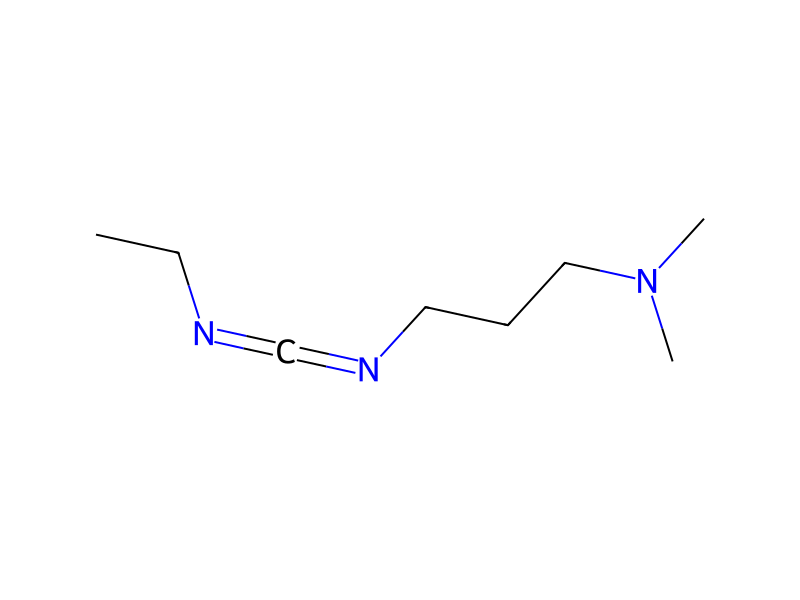
To a stirred suspension of the acid 22 (0.041 g, 0.072 mmol) in 3:1 dichloromethane-dimethylformamide (1.2 mL) was added N-ethyl-N′-(3-dimethylaminopropyl)-carbodiimide×HCl (0.027 g, 0.143 mmol) upon which a solution was obtained. The reaction mixture was stirred 10 min, after which 4-(dimethylamino)pyridine (0.009 g, 0.072 mmol) was added, and the reaction mixture was stirred another 40 min at room temperature. Then, a solution of the cyclopropylsulfonamide, prepared as described in WO03/053349, (0.035 g, 0.287 mmol) and 1,8-diazabicyclo[5.4.0]-undec-7-ene (0.043 ml, 0.287 mmol) was added and the tube was sealed and then put in the microwave at 100° C. for 40 minutes. The reaction mixture was then partitioned between ethyl acetate (20 mL), aq. 1 M hydrochloric acid and brine. The organic layer was pooled with the organic layer of another batch starting from 0.062 g, 0.108 mmol of the acid treated similar as above. The resulting solution was dried (Na2SO4), filtered and concentrated onto silica. The residue was purified by flash chromatography (gradient AcOEt:toluene 50:50 to 100:0+0.5% AcOH followed by AcOEt/MeOH, 9:1). Appropriate fractions were concentrated and further purified on Preparative HPLC (Column: ACE 5 C8, 100×21.2 mm, ACE-122-1020) using flow=15 mL/min, gradient 55% methanol/5% acetonitrile in aq. 10 mM ammonium acetate to 90% methanol in 10 min. Appropriate fractions were concentrated, re-dissolved in methanol, concentrated and lyophilized overnight to obtain an off-white solid. Finally this material was subjected to column chromatography (AcOEt/toluene, 1:1), to give 39 mg (32%) of the desired product 23 as a white powder: m/z=675 (M+H)+. 13C-NMR (125 MHz, CDCl3): 6.4, 6.5, 22.8, 24.0, 25.3, 28.0, 31.3, 33.4, 37.4, 43.0, 53.8, 56.2, 58.2, 63.7, 76.1, 98.9, 108.3, 115.4, 118.8, 123.3, 126.0, 127.4, 128.0, 128.9, 129.3, 129.6, 130.3, 131.2, 139.8, 151.4, 154.5, 158.5, 160.5, 161.6, 169.9, 175.6.
Workup
- customwas obtained
- stirringthe reaction mixture was stirred another 40 min at room temperature
- additionwas added
- customthe tube was sealed
- waitput in the microwave at 100° C. for 40 minutes
- customThe reaction mixture was then partitioned between ethyl acetate (20 mL), aq. 1 M hydrochloric acid and brine
- additiontreated similar as above
- dry with materialThe resulting solution was dried (Na2SO4)
- filtrationfiltered
- concentrationconcentrated onto silica
- customThe residue was purified by flash chromatography (gradient AcOEt:toluene 50:50 to 100:0+0.5% AcOH followed by AcOEt/MeOH, 9:1)
- concentrationAppropriate fractions were concentrated
- customfurther purified on Preparative HPLC (Column: ACE 5 C8, 100×21.2 mm, ACE-122-1020)
- customin 10 min
- concentrationAppropriate fractions were concentrated
- dissolutionre-dissolved in methanol
- concentrationconcentrated
- waitlyophilized overnight
- customto obtain an off-white solid
Sources & evidence
- ORD record
- ord-9478f1cc7f88484ea4a499d83a6aba98
- Source dataset
- uspto-grants-2014_06
- Patent number
- US08754105B2
Reaction notes
Loading…