Pivaloyl chloride → N-(3-amino-2,4-difluoro-benzyl)-2,2-dimethyl-propionamide
Reaction equation
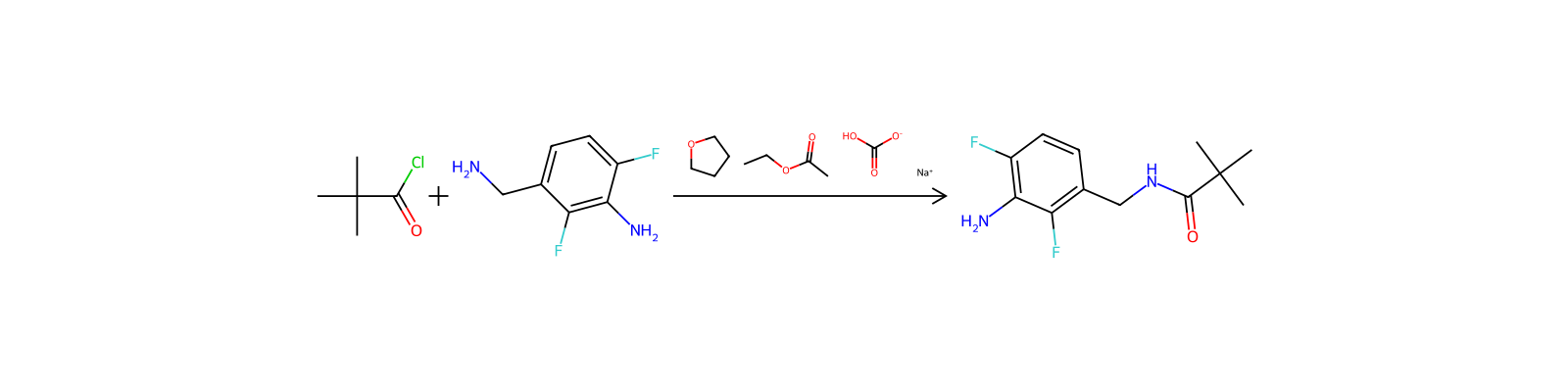
[C:1](Cl)(=[O:6])[C:2]([CH3:5])([CH3:4])[CH3:3].[NH2:8][CH2:9][C:10]1[C:11]([F:18])=[C:12]([C:14]([F:17])=[CH:15][CH:16]=1)[NH2:13]>C1COCC1.CCOC(C)=O.C([O-])(O)=O.[Na+]>[NH2:13][C:12]1[C:11]([F:18])=[C:10]([CH:16]=[CH:15][C:14]=1[F:17])[CH2:9][NH:8][C:1](=[O:6])[C:2]([CH3:5])([CH3:4])[CH3:3]Participants
6






Procedure
TEA (400 μL, 2.86 mmol) followed by pivaloyl chloride (60 μL, 0.52 mmol) are added to 3-aminomethyl-2,6-difluoro-aniline (120 mg as HCl salt) in THF (10 mL) and stirred at rt overnight. The reaction mixture is diluted with EtOAc and sat. NaHCO3-solution, the organic layer is washed with water and brine, dried and concentrated to give the sub-title compound.
Workup
- washthe organic layer is washed with water and brine
- customdried
- concentrationconcentrated
Sources & evidence
- ORD record
- ord-2f6e62d5e426477d926a631a521914f3
- Source dataset
- uspto-grants-2014_06
- Patent number
- US08759537B2
Reaction notes
Loading…