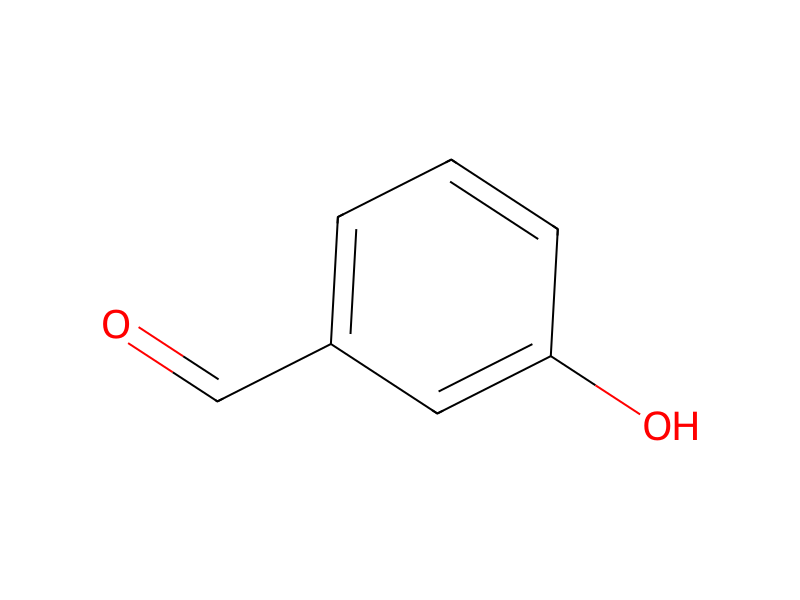
3-Hydroxybenzaldehyde → HCID 14349171, compound
Reaction equation

[OH:1][C:2]1[CH:3]=[C:4]([CH:7]=[CH:8][CH:9]=1)[CH:5]=[O:6].[H-].[Na+].C([C:14]1[CH:15]=[C:16]([CH:18]=[CH:19][CH:20]=1)[O-:17])=O.[Na+].[Na].[Cl-].[NH4+]>C1COCC1.CO>[O:17]([CH2:8][CH2:9][CH2:2][CH2:3][CH2:4][CH:5]([C:4]1[CH:3]=[C:2]([OH:1])[CH:9]=[CH:8][CH:7]=1)[OH:6])[C:16]1[CH:15]=[CH:14][CH:20]=[CH:19][CH:18]=1Participants







Procedure
A solution of 3-hydroxybenzaldehyde (5.0 g, 41 mmole) in dry THF (50 ml) was added dropwise to a well-stirred suspension of sodium hydride (2.5 g, 52 mmol; 50% oil dispersion) in dry THF (50 ml) at room temperature. The temperature was not allowed to go above ca. 40° C. After the addition of 3-hydroxybenzaldehyde was complete (ca. 30 min.) the slightly cloudy solution was warmed to 45°-50° C. and stirred for 1 hour at this temperature. The resulting clear solution of sodium 3-formyl phenoxide was cooled to room temperature and added dropwise using a cannula, to the well-stirred solution of the Grignard reagent (whose preparation was described above). A thick precipitate immediately formed. This mixture was maintained at 40°-45° C. during the addition of the sodium salt. After the addition was complete (ca. 2 hours), the reaction mixture was stirred at this temperature for another hour, and then cooled in an ice bath. The excess reactive materials (sodium hydride, Grignard reagent, etc.) were dsstroyed slowly by carefully adding methanol (30 ml), and then a saturated ammonium chloride solution (350 ml) was added to dissolve all solids. The organic layer was separated, and the aqueous layer was extracted with ether (2×75 ml). The combined organics were washed with water, brine, and then dried over anhydrous magnesium sulfate. After drying the extract, all volatiles were removed to obtain a dark liquid. This oil was triturated with a 1:1 mixture of ether and petroleum ether (35°-55° C.) when an off-white solid was obtained (12 g). This can be crystallized from methanol-ethyl acetate to give a white solid, mp 148°-9° C.
Workup
- customto go above ca. 40° C
- custom(ca. 30 min.)
- temperaturewas warmed to 45°-50° C.
- additionadded dropwise
- customA thick precipitate immediately formed
- additionAfter the addition
- custom(ca. 2 hours)
- stirringthe reaction mixture was stirred at this temperature for another hour
- temperaturecooled in an ice bath
- dissolutionto dissolve all solids
- customThe organic layer was separated
- extractionthe aqueous layer was extracted with ether (2×75 ml)
- washThe combined organics were washed with water, brine
- dry with materialdried over anhydrous magnesium sulfate
- customAfter drying the extract
- customall volatiles were removed
- customto obtain a dark liquid
- customThis oil was triturated with a 1:1 mixture of ether and petroleum ether (35°-55° C.) when an off-white solid
- customwas obtained (12 g)
- customThis can be crystallized from methanol-ethyl acetate
- customto give a white solid, mp 148°-9° C.
Sources & evidence
- ORD record
- ord-69e5e8e495d540b7a30da2b7e5ac0f8e
- Source dataset
- uspto-grants-1988_12
- Patent number
- US04794188
Reaction notes
Loading…