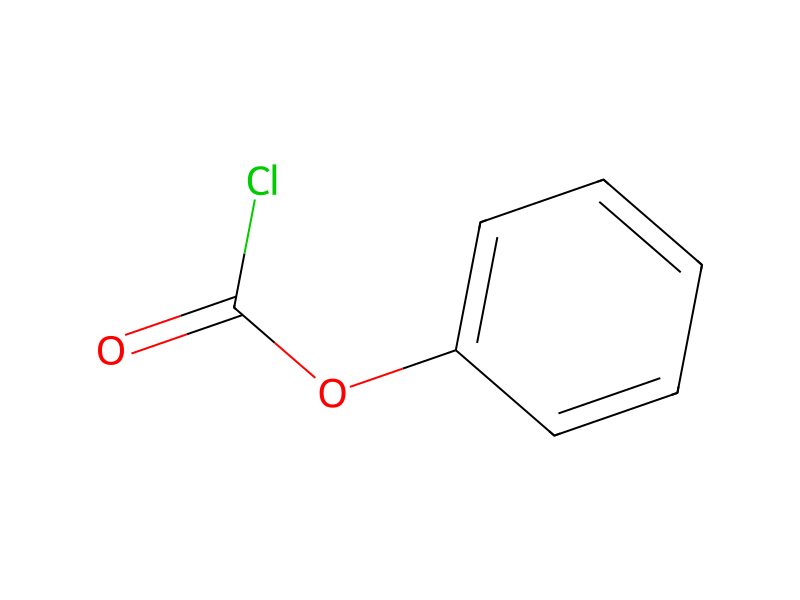
Phenyl chloroformate → HCID 23153594, compound
Reaction equation

[NH2:1][C:2]1[CH:7]=[C:6]([O:8][C:9]2[CH:14]=[CH:13][C:12]([N+:15]([O-])=O)=[CH:11][C:10]=2[Cl:18])[N:5]=[CH:4][N:3]=1.Cl[C:20](OC1C=CC=CC=1)=[O:21].[NH:29]1[CH2:33][CH2:32][CH2:31][CH2:30]1.[Cl-].[NH4+]>O1CCCC1.[Fe].O.C(O)C.C(N(CC)CC)C>[NH2:15][C:12]1[CH:13]=[CH:14][C:9]([O:8][C:6]2[CH:7]=[C:2]([NH:1][C:20]([N:29]3[CH2:33][CH2:32][CH2:31][CH2:30]3)=[O:21])[N:3]=[CH:4][N:5]=2)=[C:10]([Cl:18])[CH:11]=1Participants
Reactant 4



Product 1

Reagents, catalysts & solvents 5





Procedure
4-Amino-6-(2-chloro-4-nitropenoxy)pyrimidine (230 mg) was dissolved in tetrahydrofuran (5 ml) under a nitrogen atmosphere, and then triethylamine (0.24 ml) and phenyl chloroformate (0.216 ml) were added dropwise thereto while cooling in an ice bath, followed by stirring at room temperature for 1 hr. Pyrrolidine (0.507 ml) was added thereto, followed by stirring for another 1 hr. The reaction mixture was partitioned between ethyl acetate and a saturated aqueous solution of ammonium chloride. The organic layer was washed with a saturated aqueous solution of ammonium chloride, water, a saturated aqueous solution of sodium hydrogencarbonate and brine in this order, and dried over anhydrous sodium sulfate. The solvent was evaporated under a reduced pressure to give a residue, to which ethanol (20 ml)-water (5 ml) was added to dissolve, and then electrolytic iron powder (400 mg) and ammonium chloride (800 mg) were added thereto, followed by heating under reflux for 2 hr. The reaction mixture was cooled down to room temperature, and filtered through celite to remove an insoluble portion, which was washed with ethyl acetate-tetrahydrofuran (1:1) and water. The organic layer of the filtrate was separated, washed with water and brine in this order, and dried over anhydrous sodium sulfate. The solvent was evaporated under a reduced pressure to give a residue, which was then purified by silica gel column chromatography (eluent; hexane:ethyl acetate=1:4, then ethyl acetate) to provide the titled compound (145.5 mg, 51%) as white powder.
Workup
- temperaturewhile cooling in an ice bath
- stirringby stirring for another 1 hr
- customThe reaction mixture was partitioned between ethyl acetate
- washThe organic layer was washed with a saturated aqueous solution of ammonium chloride, water
- dry with materiala saturated aqueous solution of sodium hydrogencarbonate and brine in this order, and dried over anhydrous sodium sulfate
- customThe solvent was evaporated under a reduced pressure
- customto give a residue
- dissolutionto dissolve
- temperatureby heating
- temperatureunder reflux for 2 hr
- temperatureThe reaction mixture was cooled down to room temperature
- filtrationfiltered through celite
- customto remove an insoluble portion, which
- washwas washed with ethyl acetate-tetrahydrofuran (1:1) and water
- customThe organic layer of the filtrate was separated
- washwashed with water and brine in this order
- dry with materialdried over anhydrous sodium sulfate
- customThe solvent was evaporated under a reduced pressure
- customto give a residue, which
- customwas then purified by silica gel column chromatography (eluent
Sources & evidence
- ORD record
- ord-f500482d12744586bc4551868b575b0c
- Source dataset
- uspto-grants-2009_05
- Patent number
- US07531532B2
Reaction notes
Loading…