Hydrochloric Acid → Methyl 4-(2-methoxyethoxy)benzoate
Reaction equation

[CH3:1][O:2][CH:3](O)[CH3:4].C1(P(C2C=CC=CC=2)C2C=CC=CC=2)C=CC=CC=1.[OH:25][C:26]1[CH:35]=[CH:34][C:29]([C:30]([O:32][CH3:33])=[O:31])=[CH:28][CH:27]=1.N(C(OC(C)C)=O)=NC(OC(C)C)=O.Cl>C1COCC1.O>[CH3:1][O:2][CH2:3][CH2:4][O:25][C:26]1[CH:27]=[CH:28][C:29]([C:30]([O:32][CH3:33])=[O:31])=[CH:34][CH:35]=1Participants
Reactant 5

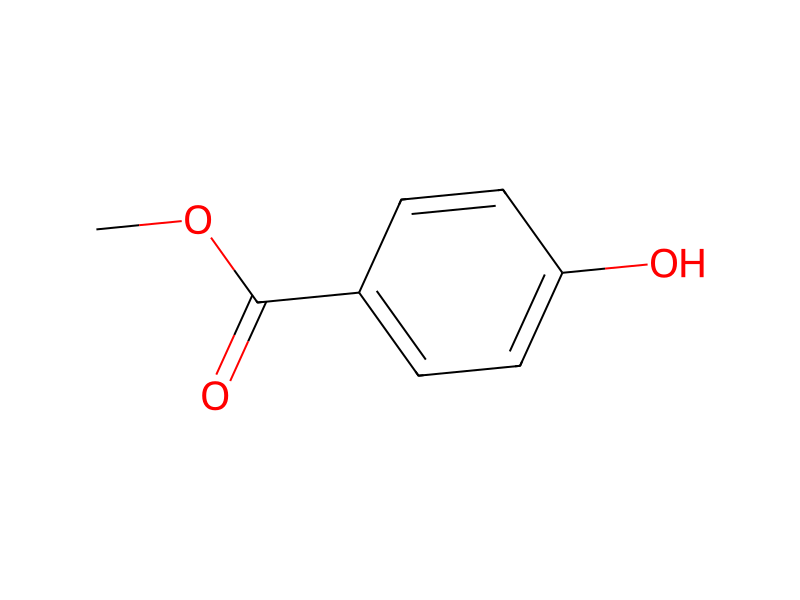



Product 1

Reagents, catalysts & solvents 2


Conditions
- Temperature
- 10 °C
Procedure
4.3 mL (37.5 mmol) of methoxyethanol and 10.1 g (37.5 mmol) of triphenylphosphine are added to a solution of 61 g (30 mmol) of methyl 4-hydroxybenzoate in 120 ml of THF at room temperature. 7.7 mL (37.5 mmol) of diisopropyl azodicarboxylate (DIAD) in 110 mL of THF are incorporated slowly so that the temperature is maintained to 10° C. After 18 hours at room temperature, the reaction mixture is poured onto icy water and acidified with a 1N HCl solution. The aqueous phase is extracted with ethyl acetate and the organic phase is then washed repeatedly with water, dried over sodium sulfate, filtered and concentrated by rotary evaporation. Chromatography of the residue using cyclohexane: ethyl acetate 4:1 yielded 6.6 g (98%) of pure methyl 4-(2-methoxyethoxy)benzoate as a white powder.
Workup
- extractionThe aqueous phase is extracted with ethyl acetate
- washthe organic phase is then washed repeatedly with water
- dry with materialdried over sodium sulfate
- filtrationfiltered
- concentrationconcentrated by rotary evaporation
Sources & evidence
- ORD record
- ord-34c0d3b6499a4e2e8b831e8c9fded0e0
- Source dataset
- uspto-grants-2016_05
- Patent number
- US09334366B2
Reaction notes
Loading…