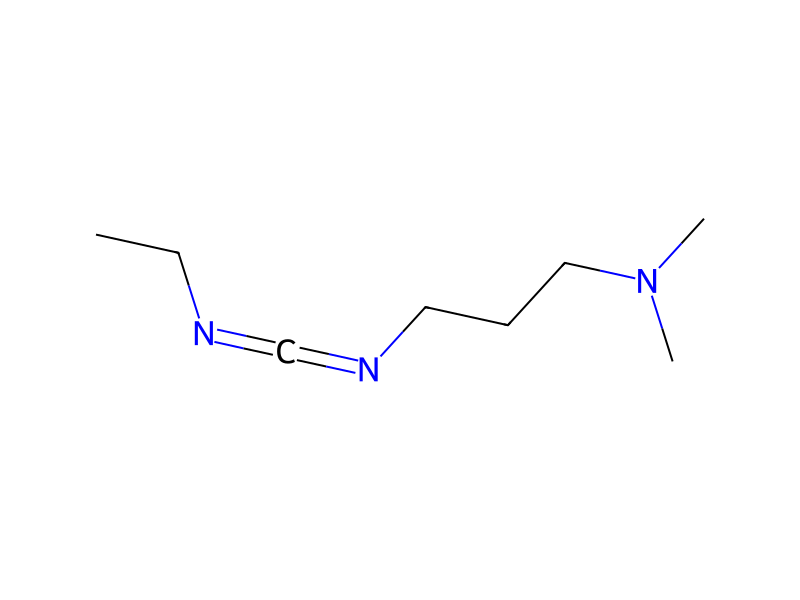
Pyridine → 1-Ethyl-3-(3'-dimethylaminopropyl)carbodiimide
Reaction equation

[NH2:1][C:2]1[CH:7]=CC=CC=1.C(Cl)(=O)C=C.C(=O)(O)[O-].[Na+].[CH:18]([N:21]([CH:24]([CH3:26])C)[CH2:22]C)(C)C.C(O)(=O)C=C.[N:32]1[CH:37]=CC=C[CH:33]=1>C(N(CC)CC)C.C(Cl)Cl>[CH2:2]([N:1]=[C:33]=[N:32][CH2:37][CH2:26][CH2:24][N:21]([CH3:18])[CH3:22])[CH3:7]Participants
Reactant 6






Product 1
Reagents, catalysts & solvents 2


Procedure
Subsequently, the aniline compound of formula (II) is subjected to a reaction with an acryloyl chloride substituted with A and B, in an organic solvent (e.g., methylene chloride or tetrohydrofuran) or a mixed solvent such as 50% aqueous tetrohydrofuran in the presence of an inorganic base (e.g., sodium bicarbonate) or organic base (e.g., triethylamine or diisopropylethylamine) at a low temperature ranging from −10° C. to 10° C.; or with acrylic acid substituted with A and B, in pyridine using a coupling agent (e.g., 1-ethyl-3-(3-dimethylaminopropyl)carbodiimide (EDCI) or 2-(1H-7-azabenzotriazol-1-yl)-1,1,3,3-tetramethyl uronium hexafluoro phosphate methaneaminium (HATU)), to obtain the inventive compound of formula (I) having an acrylamide group.
Workup
- customranging from −10° C. to 10° C.
Sources & evidence
- ORD record
- ord-62ae1e085d6340ebb3b7f3b0b566951b
- Source dataset
- uspto-grants-2016_05
- Patent number
- US09345719B2
Reaction notes
Loading…