Cesium carbonate → 2-Chloro-3-cyclopropylpyrazolo[1,5-A]pyridine
Reaction equation

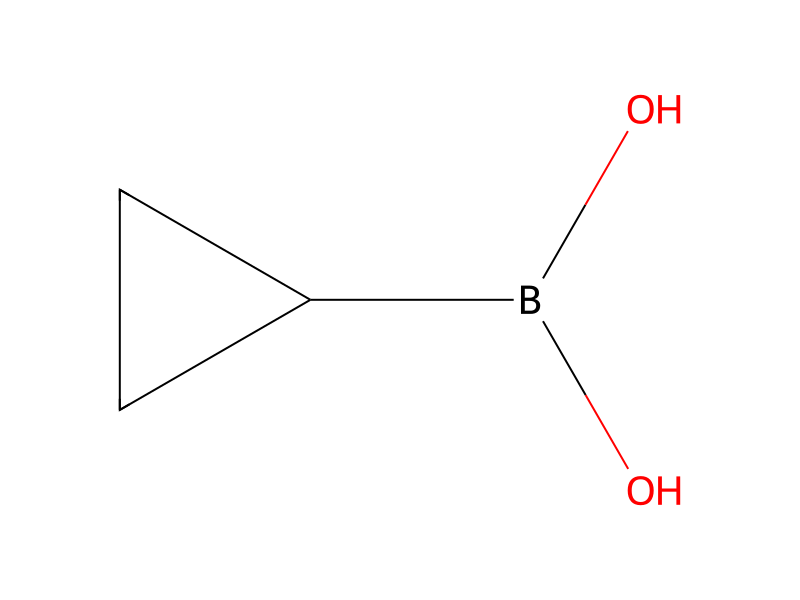
[Cl:1][C:2]1[C:10](I)=[C:5]2[CH:6]=[CH:7][CH:8]=[CH:9][N:4]2[N:3]=1.[CH:12]1(B(O)O)[CH2:14][CH2:13]1.C(=O)([O-])[O-].[Cs+].[Cs+].C1(P(C2C=CC=CC=2)C2C=CC=CC=2)C=CC=CC=1>O1CCCC1.C([O-])(=O)C.[Pd+2].C([O-])(=O)C>[Cl:1][C:2]1[C:10]([CH:12]2[CH2:14][CH2:13]2)=[C:5]2[CH:6]=[CH:7][CH:8]=[CH:9][N:4]2[N:3]=1Participants
Reactant 4



Product 1

Reagents, catalysts & solvents 2


Conditions
- Temperature
- 100 °C
Procedure
A mixture 2-chloro-3-iodopyrazolo-[1,5-a]pyridine (27-3; 0.7 g, 2.52 mmol), cyclopropyl boronic acid (0.43 g, 5.036 mmol), and cesium carbonate (2.46 g, 7.56 mmol), in tetrahydrofuran (15.0 mL) was degassed for 10 min. Then triphenylphosphine (0.132 g, 0.504 mmol) and palladium acetate (0.056 g, 0.252 mmol) were added and heated in a sealed tube at 100° C. for 18 h. The reaction mixture was then cooled to room temperature, filtered and concentrated under reduced pressure. Purification of the resulting residue by flash chromatography on silica gel (0-5% ethyl acetate in hexanes) provided 2-chloro-3-cyclopropylpyrazolo[1,5-a]pyridine. 1H NMR (400 MHz, CDCl3) δ 8.29-8.27 (d, J=7.2 Hz, 1 H), 7.50-7.48 (d, J=8.8 Hz, 1 H), 7.11-7.07 (t, J=7.8 Hz, 1 H), 6.72-6.69 (m, 1 H), 1.80-1.73 (m, 1 H), 0.98-0.95 (m, 2 H), 0.75-0.73 (m, 2 H). MS (M+1): 139.1.
Workup
- temperatureThe reaction mixture was then cooled to room temperature
- filtrationfiltered
- concentrationconcentrated under reduced pressure
- customPurification of the resulting residue by flash chromatography on silica gel (0-5% ethyl acetate in hexanes)
Sources & evidence
- ORD record
- ord-d627c17449db46f8acb10a2d0803dcae
- Source dataset
- uspto-grants-2016_05
- Patent number
- US09351973B2
Reaction notes
Loading…