Acetyl chloride → Methyl 7-bromo-2-methylbenzo[d]oxazole-4-carboxylate
Reaction equation

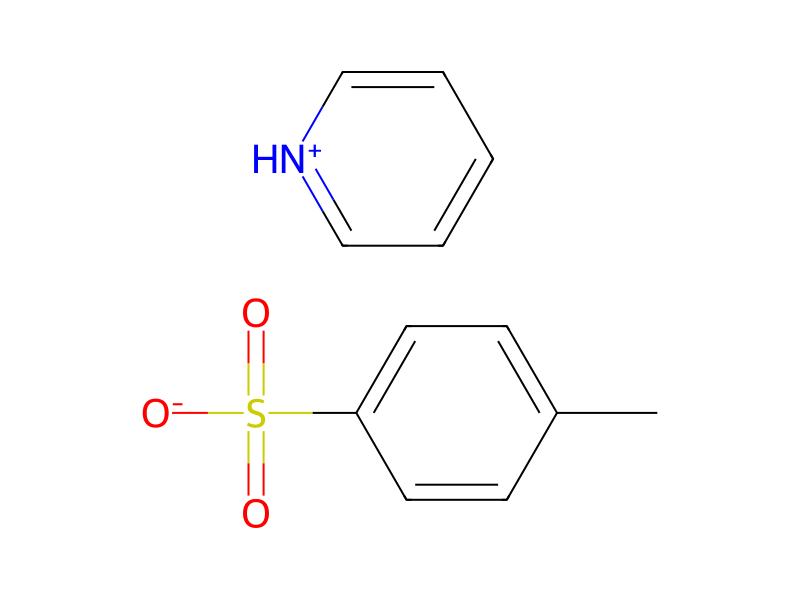
[CH3:1][O:2][C:3](=[O:13])[C:4]1[CH:9]=[CH:8][C:7]([Br:10])=[C:6]([OH:11])[C:5]=1[NH2:12].[CH2:14](N(CC)CC)[CH3:15].C1(C)C=CC(S([O-])(=O)=O)=CC=1.[NH+]1C=CC=CC=1.C(Cl)(=O)C>C1(C)C=CC=CC=1.Cl.C(OCC)(=O)C>[CH3:1][O:2][C:3]([C:4]1[CH:9]=[CH:8][C:7]([Br:10])=[C:6]2[O:11][C:14]([CH3:15])=[N:12][C:5]=12)=[O:13]Participants
Reactant 4



Product 1

Reagents, catalysts & solvents 3



Procedure
To a solution of 2-amino-4-bromo-3-hydroxy-benzoic acid methyl ester (2.46 g) in toluene (250 ml) was added sequentially triethylamine (1.53 ml), pyridinium p-toluenesulfonate (“PPTS”) (0.75 g) and acetyl chloride (0.78 ml). The reaction mixture was heated at reflux for 16 hours. The reaction mixture was cooled to ambient temperature and diluted with aqueous hydrochloric acid (1M) (100 ml) and ethyl acetate (200 ml). The phases were separated and the organic extract was washed with aqueous hydrochloric acid (1M) (150 ml) and brine (150 ml) and then dried over sodium sulfate. The solids were removed by filtration and the filtrate was concentrated to give 7-bromo-2 methyl-benzo[d]oxazole-4-carboxylic acid methyl ester (2.94 g). 1H-NMR (400 MHz, CDCl3): 7.87 (d, 1H), 7.52 (d, 1H), 4.04 (s, 3H), 2.77 (s, 3H) ppm.
Workup
- temperatureThe reaction mixture was heated
- temperatureat reflux for 16 hours
- customThe phases were separated
- extractionthe organic extract
- washwas washed with aqueous hydrochloric acid (1M) (150 ml) and brine (150 ml)
- dry with materialdried over sodium sulfate
- customThe solids were removed by filtration
- concentrationthe filtrate was concentrated
Sources & evidence
- ORD record
- ord-25536a5a7ca64db5a2fad617c68eaae3
- Source dataset
- uspto-grants-2014_10
- Patent number
- US08859592B2
Reaction notes
Loading…