Diisopropylethylamine → 2-{4-[(1-Ethoxycarbonyl-ethoxy)-methoxy-phosphoryl]-but-2-enyl}-6-[6-methoxy-7-methyl-3-oxo-4-(2-trimethylsilanyl-ethoxy)-1,3-dihydro-isobenzofuran-5-yl]-4-methyl-hex-4-enoic acid 2-trimethylsilanyl-ethyl Ester
Reaction equation

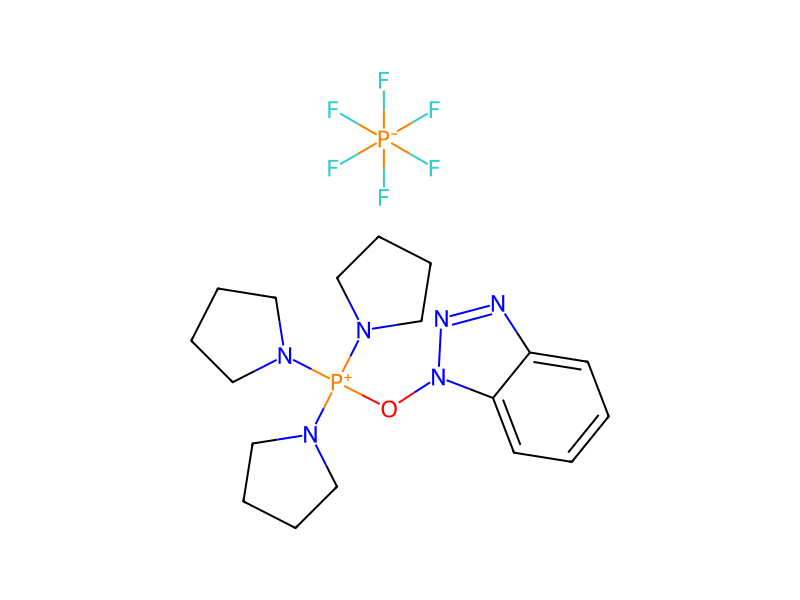
[CH3:1][Si:2]([CH3:44])([CH3:43])[CH2:3][CH2:4][O:5][C:6](=[O:42])[CH:7]([CH2:33][CH:34]=[CH:35][CH2:36][P:37]([OH:41])([O:39][CH3:40])=[O:38])[CH2:8][C:9]([CH3:32])=[CH:10][CH2:11][C:12]1[C:13]([O:25][CH2:26][CH2:27][Si:28]([CH3:31])([CH3:30])[CH3:29])=[C:14]2[C:18](=[C:19]([CH3:23])[C:20]=1[O:21][CH3:22])[CH2:17][O:16][C:15]2=[O:24].C1CN([P+](ON2N=NC3C=CC=CC2=3)(N2CCCC2)N2CCCC2)CC1.F[P-](F)(F)(F)(F)F.[C:78]([O:83][CH2:84][CH3:85])(=[O:82])[C@H:79]([CH3:81])O.CCN(C(C)C)C(C)C>CN(C=O)C>[CH3:44][Si:2]([CH3:43])([CH3:1])[CH2:3][CH2:4][O:5][C:6](=[O:42])[CH:7]([CH2:33][CH:34]=[CH:35][CH2:36][P:37]([O:41][CH:79]([C:78]([O:83][CH2:84][CH3:85])=[O:82])[CH3:81])([O:39][CH3:40])=[O:38])[CH2:8][C:9]([CH3:32])=[CH:10][CH2:11][C:12]1[C:13]([O:25][CH2:26][CH2:27][Si:28]([CH3:31])([CH3:30])[CH3:29])=[C:14]2[C:18](=[C:19]([CH3:23])[C:20]=1[O:21][CH3:22])[CH2:17][O:16][C:15]2=[O:24]Participants
Reactant 4



Product 1

Reagents, catalysts & solvents 1

Procedure
A solution of 2-[4-(hydroxy-methoxy-phosphoryl)-but-2-enyl]-6-[6-methoxy-7-methyl-3-oxo-4-(2-trimethylsilanyl-ethoxy)-1,3-dihydro-isobenzofuran-5-yl]-4-methyl-hex-4-enoic acid 2-trimethylsilanyl-ethyl ester (67 mg, 0.10 mmol) and PyBOP (234 mg, 0.450 mmol) in DMF (1.5 mL) was stirred with ethyl (S)-(−)-lactate (53 mg, 0.45 mmol) and DIEA (174 μL, 1.00 mmol) at ambient temperature for 1 hour, when complete consumption of the starting materials was observed. The reaction was worked up by addition of saturated aqueous sodium chloride and ethyl acetate. The organic layer was separated and washed with 5% aqueous solution of lithium chloride. The organic layer was dried in vacuo and the residue was purified by silica gel chromatography using MeOH—CH2Cl2 (0-20%) to provide 57 mg (74%) of the desired product as a clear oil. 1H NMR (300 MHz, CDCl3) δ 0.02 (s, 9H), 0.05 (s, 9H), 0.88-0.94 (m, 2H), 1.20-1.30 (m, 2H), 1.29 (t, 3H, J=7 Hz), 1.45 (d, 3H, J=7 Hz), 1.78 (s, 3H), 2.01-2.31 (m, 4H), 2.17 (s, 3H), 2.50-2.58 (m, 1H), 2.65 (d, 1H, J=22 Hz), 2.67 (d, 1H, J=22 Hz), 3.39 (d, 2H, J=7 Hz), 3.69 and 3.77 (d, 3H, J=11 Hz), 3.76 (s, 3H), 4.07 (appt t, 2H, J=7 Hz), 4.20 (dq, 2H, J=3, 7 Hz), 4.29 (appt t, 2H, J=9 Hz), 4.85-4.99 (m, 1H), 5.12 (s, 2H), 5.19 (br t, 1H, J=6 Hz), 5.33-5.61 (m, 2H) ppm; 31P (121.4 MHz, CDCl3) δ 28.9, 29.9 ppm; MS (m/z) 791.4 [M+Na]+.
Workup
- customwhen complete consumption of the starting materials
- additionThe reaction was worked up by addition of saturated aqueous sodium chloride and ethyl acetate
- customThe organic layer was separated
- washwashed with 5% aqueous solution of lithium chloride
- customThe organic layer was dried in vacuo
- customthe residue was purified by silica gel chromatography
Sources & evidence
- ORD record
- ord-027efca6662b40029c0fc6182c0d9092
- Source dataset
- uspto-grants-2014_10
- Patent number
- US08871785B2
Reaction notes
Loading…