Hydrochloric Acid → HCID 118059637, compound
Reaction equation

Cl[S:2]([N:5]=[C:6]=[O:7])(=[O:4])=[O:3].[Cl:8][C:9]([Cl:13])([Cl:12])[CH2:10][OH:11].[CH3:14][O:15][CH:16]([O:19][CH3:20])[CH2:17][NH2:18].C(N(CC)CC)C.Cl>ClCCl>[CH3:14][O:15][CH:16]([O:19][CH3:20])[CH2:17][NH:18][S:2]([NH:5][C:6](=[O:7])[O:11][CH2:10][C:9]([Cl:13])([Cl:12])[Cl:8])(=[O:4])=[O:3]Participants

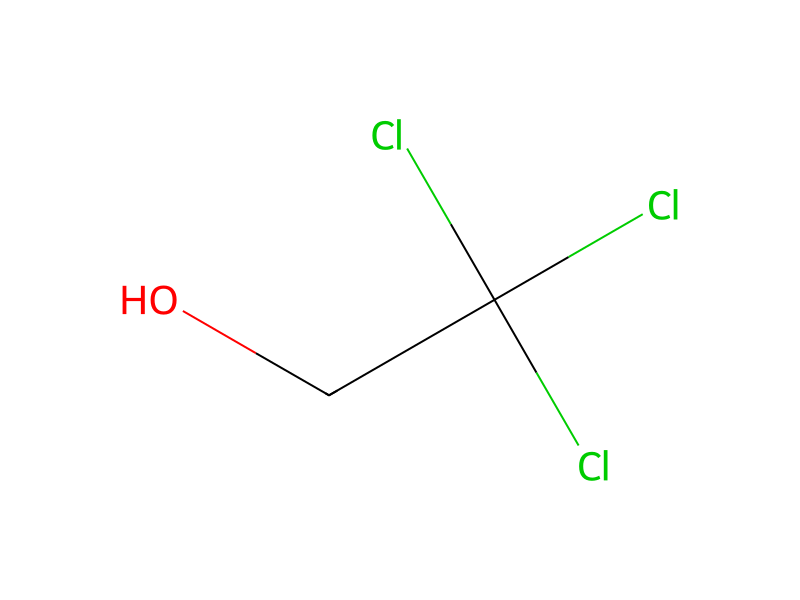




Conditions
- Temperature
- 0 °C
Procedure
A solution of chlorosulfonylisocyanate (6.96 mL, 80 mmol) in dichloromethane (120 mL) was cooled to 0° C. 2,2,2-trichloroethanol (7.67 mL, 80.0 mmol, 1.0 equiv.) was added via addition funnel at 0° C. This mixture was stirred at 0° C. for 1.5 h. To this mixture was then added a solution of aminoacetaldehyde dimethyl acetal (8.76 mL, 80.0 mmol, 1.0 equiv.) and triethylamine (TEA, 33.4 mL, 240 mmol, 3.0 equiv.) in dichloromethane (DCM, 120.0 mL) added drop-wise via addition funnel at 0° C. The reaction was warmed to room temperature and stirred at room temperature overnight. The reaction was treated with 0.1 N hydrochloric acid and the collected organic phase was washed with brine, dried over Na2SO4, and concentrated to give the desired product (28.01 g, 97%) as a crude off-white solid, which was used in the subsequent reaction without further purification. 1H NMR (300 MHz, DMSO-d6) δ 11.79 (s, 1H), 8.08 (t, 1H, J=5.9 Hz), 4.90 (s, 2H), 4.37 (t, 1H, J=5.5 Hz), 3.23 (s, 6H), 3.00 (dd, 2H, J=5.7 Hz).
Workup
- additionadded drop-wise
- additionvia addition funnel at 0° C
- temperatureThe reaction was warmed to room temperature
- stirringstirred at room temperature overnight
- washthe collected organic phase was washed with brine
- dry with materialdried over Na2SO4
- concentrationconcentrated
Sources & evidence
- ORD record
- ord-a4840d23e2d0449a890aead166a964a0
- Source dataset
- uspto-grants-2016_04
- Patent number
- US09321755B2
Reaction notes
Loading…