Triethylamine → 3-((Trimethylsilyl)ethynyl)benzamide
Reaction equation
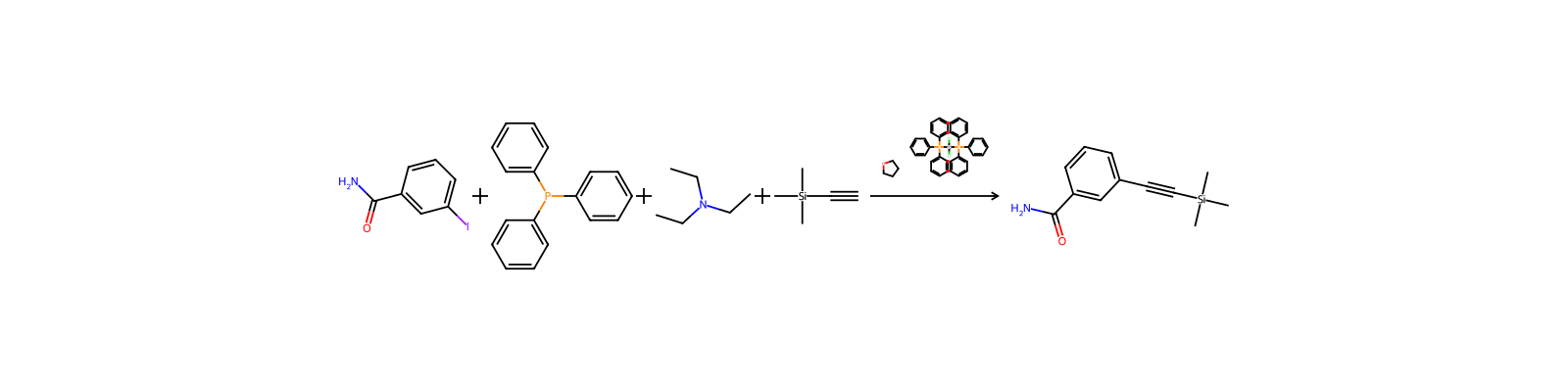
I[C:2]1[CH:3]=[C:4]([CH:8]=[CH:9][CH:10]=1)[C:5]([NH2:7])=[O:6].C1(P(C2C=CC=CC=2)C2C=CC=CC=2)C=CC=CC=1.C(N(CC)CC)C.[Si:37]([C:41]#[CH:42])([CH3:40])([CH3:39])[CH3:38]>C1COCC1.Cl[Pd](Cl)([P](C1C=CC=CC=1)(C1C=CC=CC=1)C1C=CC=CC=1)[P](C1C=CC=CC=1)(C1C=CC=CC=1)C1C=CC=CC=1>[CH3:38][Si:37]([C:41]#[C:42][C:2]1[CH:3]=[C:4]([CH:8]=[CH:9][CH:10]=1)[C:5]([NH2:7])=[O:6])([CH3:40])[CH3:39]Participants
7







Procedure
A solution of 3-iodobenzamide (I29) (1.65 g, 6.66 mmol), Cu(I)I (127 mg, 0.666 mmol) and triphenylphosphine (524 mg, 2.00 mmol) in THF (100 mL) and triethylamine (4.64 mL, 33.3 mmol) was sonicated for 10 minutes under a nitrogen atmosphere. PdCl2(PPh3)2 (642 mg, 0.67 mmol) and TMS acetylene (1.88 mL, 13.3 mmol) were then added and the reaction stirred at room temperature for 3 days. The volatiles were evaporated in vacuo and the residue chromatographed on silica gel (0-50% ethyl acetate/petroleum benzine 40-60° C.) to give the title compound (I30) (1.53 g); 1H NMR (400 MHz, CDCl3) δ 7.78 (t, J=1.5 Hz, 1H), 7.67 (ddd, J=7.8, 1.8, 1.2 Hz, 1H), 7.53-7.48 (m, 1H), 7.29 (td, J=7.8, 0.5 Hz, 1H), 0.15 (s, 9H).
Workup
- customThe volatiles were evaporated in vacuo
- customthe residue chromatographed on silica gel (0-50% ethyl acetate/petroleum benzine 40-60° C.)
Sources & evidence
- ORD record
- ord-fa473d889e3b4152beb04e3db298ac90
- Source dataset
- uspto-grants-2015_11
- Patent number
- US09174946B2
Reaction notes
Loading…