4-Methylmorpholine → 5-bromo-N-(imidazo[1,2-a]pyridin-7-ylmethyl)thiophene-2-carboxamide
Reaction equation

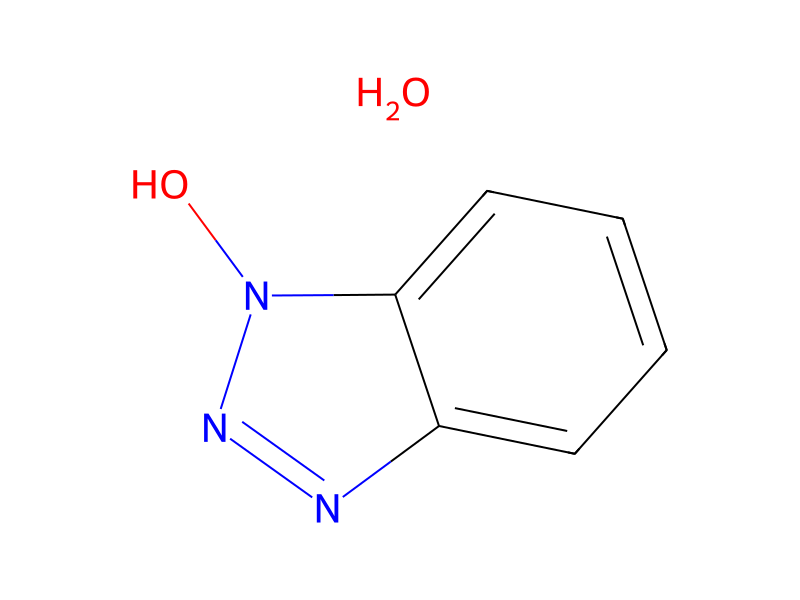
[Br:1][C:2]1[S:6][C:5]([C:7]([OH:9])=O)=[CH:4][CH:3]=1.[N:10]1[CH:11]=[CH:12][N:13]2[CH:18]=[CH:17][C:16]([CH2:19][NH2:20])=[CH:15][C:14]=12.O.ON1C2C=CC=CC=2N=N1.CN1CCOCC1.Cl.CN(C)CCCN=C=NCC>CN(C)C=O.C(OCC)(=O)C.O>[Br:1][C:2]1[S:6][C:5]([C:7]([NH:20][CH2:19][C:16]2[CH:17]=[CH:18][N:13]3[CH:12]=[CH:11][N:10]=[C:14]3[CH:15]=2)=[O:9])=[CH:4][CH:3]=1Participants
9
Reactant 5




Product 1

Reagents, catalysts & solvents 3



Procedure
A solution of 5-bromothiophene-2-carboxylic acid (1.279 g, 6.18 mmol), imidazo[1,2-a]pyridin-7-ylmethanamine (1 g, 6.79 mmol), 1-hydroxybenzotriazole hydrate (1.041 g, 6.79 mmol) and N-methylmorpholine (1.698 ml, 15.44 mmol) in dimethylformamide (20 ml) at room temperature was treated with 1-(3-dimethylaminopropyl)-3-ethylcarbodiimide hydrochloride (2.131 g, 11.12 mmol). The mixture was stirred overnight and poured into a gently stirred round-bottom flask containing water (100 ml) and ethyl acetate (30 ml). The resulting bilayer suspension was stirred for several minutes, filtered and washed with water then minimal ethyl acetate to give the title compound after drying.
Workup
- additionpoured into a gently stirred round-bottom flask
- stirringThe resulting bilayer suspension was stirred for several minutes
- filtrationfiltered
- washwashed with water
Sources & evidence
- ORD record
- ord-8c8801af4b83495fb6361d4d49db337e
- Source dataset
- uspto-grants-2015_11
- Patent number
- US09193723B2
Reaction notes
Loading…