Hydrogen Peroxide → Anthraquinone
Reaction equation

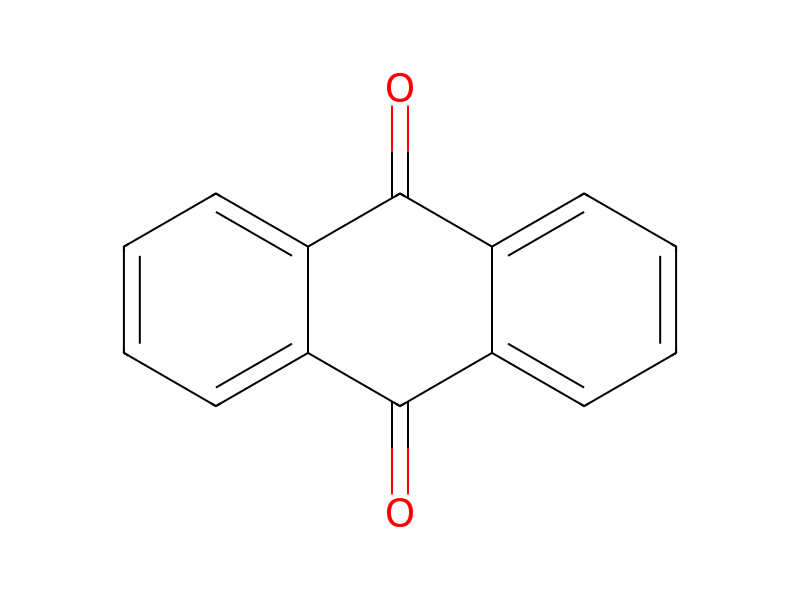
[CH:1]1[C:14]2[CH:13]([OH:15])[C:12]3[C:7](=[CH:8][CH:9]=[CH:10][CH:11]=3)[CH:6]([OH:16])[C:5]=2[CH:4]=[CH:3][CH:2]=1.ON1C(=O)C2=CC=CC=C2C1=O.O=O.OO>C(OCC)(=O)C>[CH:8]1[C:7]2[C:6](=[O:16])[C:5]3[C:14](=[CH:1][CH:2]=[CH:3][CH:4]=3)[C:13](=[O:15])[C:12]=2[CH:11]=[CH:10][CH:9]=1Participants
6
Reactant 4




Product 1
Reagents, catalysts & solvents 1

Procedure
A mixture of 5 mmol of 9,10-dihydroanthracene-9,10-diol, 0.5 mmol of N-hydroxyphthalimide, and 5 ml of ethyl acetate was stirred at 75° C. in an oxygen atmosphere (1 atm) for 18 hours. An iodometric analysis of a reaction mixture revealed that hydrogen peroxide was formed in yield of 36%. Separately, as a result of a gas chromatographic analysis of the reaction mixture, the conversion rate from 9,10-dihydroanthracene-9,10-diol was 27%, and anthraquinone was formed in yield of 24%.
Workup
- customwas formed in yield of 36%
- customSeparately, as a result of a gas chromatographic analysis of the reaction mixture
Sources & evidence
- ORD record
- ord-8dc29075ff0b446293e048fb8c31a87f
- Source dataset
- uspto-grants-2002_04
- Patent number
- US06375922B1
Reaction notes
Loading…