3-Hydroxypyridine → 3-Hydroxypyridine
Reaction equation

[NH2-:1].[Na+].C(O)(=O)CCCCCCC/C=C\CCCCCCCC.[OH:23][C:24]1[CH:25]=[N:26][CH:27]=[CH:28][CH:29]=1>C1(C)C(C)=CC=CC=1>[OH:23][C:24]1[CH:25]=[N:26][CH:27]=[CH:28][CH:29]=1.[NH2:1][C:25]1[C:24]([OH:23])=[CH:29][CH:28]=[CH:27][N:26]=1Participants
Reactant 3

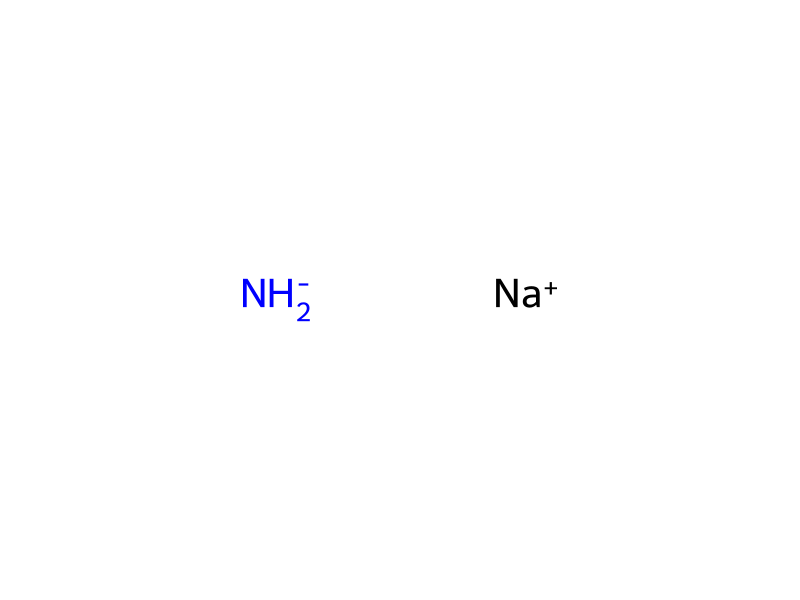

Product 2

Reagents, catalysts & solvents 1

Procedure
A mixture of 89.7 g (2.3 moles) of sodamide, 500 cc of xylene containing 0.1 cc of oleic acid and 95 g (1 mole) of 3-hydroxypyridine was placed in a Magne Drive as described in Example 2. The autoclave was closed and purged of air with ammonia, pressurized with ammonia to 40 psig and to 200 psig with nitrogen. The pressure relief valve was set at 350 psig. The mixture was heated (158°-186°) for almost 5 hours, during which time hydrogen was evolved. The autoclave was cooled to room temperature, vented to atmospheric pressure and hydrolyzed with 250 cc of water. The temperature during the hydrolysis was 60° C. The aqueous phase was separated and neutralized to pH 7.0 with concentrated hydrochloric acid. It was extracted 3 times with 4-picoline. The picoline extracts were combined and distilled to give 39.3 g of recovered 3-hydroxypyridine and 40.6 g of 2-amino-3-hydroxypyridine boiling 223°-228° C. at 29 mm. The melting point of the 2-amino-3-hydroxypyridine, recrystallized from methanol-xylene, was 162°-163° C. The structure was confirmed by NMR and the IR spectrum was identical to the spectrum of 2-amino-3-hydroxypyridine found in Aldrich Library of Infrared Spectra, 2nd ed., p. 1157E. The yield of 2-amino-3-hydroxypyridine, based on 3-hydroxypyridine recovered, was 62.9%. This result significantly differed from the literature report by Levitt and Levitt, Chemistry and Industry, 1621 (1963) which reports the amination of 3-hydroxypyridine gave 2,6-diaminopyridine in good yield while also pointing out that 2-amino-3-hydroxypyridine should, in fact, not be obtained. This is not true of applicants' discovery. The recovered 2-amino-3-hydroxypyridine was found useful, for example, in preparing prostaglandin synthetase inhibitors as reported in Belg. Patent 830,786 (1975), in preparing antiinflammatory agents, analgesics and antipyretics as reported in Shen, et al., Ger. Offen. 2,330,109 (1974), and in preparing antibacterials as reported in Meszaros et al., Hung Teljes, 10,957 (1975). The 2-amino-3-hydroxypyridine was also found useful in the preparation of metalized azo dyes for dying wool, polyamide, and acrylic fibers as reported in Back and Buehler, Ger. Offen. Nos. 2,236,299 (1973) and 2,236,269 (1973).
Workup
- customThe autoclave was closed
- custompurged of air with ammonia
- temperatureThe mixture was heated (158°-186°) for almost 5 hours
- customwas 60° C
- customThe aqueous phase was separated
- extractionIt was extracted 3 times with 4-picoline
- distillationdistilled
Sources & evidence
- ORD record
- ord-1a95981d7999400eb108dc1a739d91c2
- Source dataset
- uspto-grants-1983_05
- Patent number
- US04386209
Reaction notes
Loading…