Hydrochloric Acid → HCID 66647628, compound
Reaction equation

[NH:1]1[CH:5]=[CH:4][CH:3]=[N:2]1.[NH:6]1C=C[CH:9]=[CH:8][C:7]1=O.FC(F)(F)C(O)=[O:16].[N+]([O-])(O)=O.S(=O)(=O)(O)O.Cl.FC(F)(F)C(O)=O.C(Cl)Cl.Cl.C(O)(C)C.C1COCC1.Cl.O.C1COCC1>C(O)(C)C.C(Cl)Cl.C1COCC1.O>[N:1]1[C:5]2[CH:9]=[CH:8][CH:7]=[N:6][C:4]=2[C:3](=[O:16])[N:2]=1Participants
Reactant 7




Product 1

Reagents, catalysts & solvents 4




Procedure
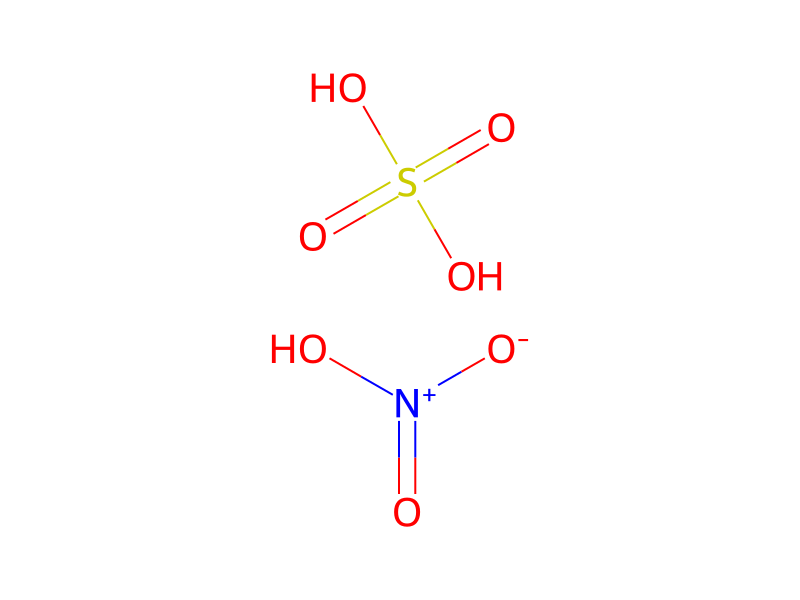
Fused pyrazoline (III) can be converted to its corresponding pyrazole-pyridinone (IV) by treatment with an acid. This deamination reaction is preferably performed in the presence of a strong acid (e.g., trifluoroacetic acid (TFA), sulfuric acid nitric acid, and hydrochloric acid (HCl)). An aprotic solvent may be used (e.g., CH2Cl2 or THF). As one of ordinary skill in the art recognizes, some acids are usually available in the presence of a second solvent. For example, 6N HCl can be available in isopropyl alcohol (IPA). 2N HCl can be available as an aqueous solution. Thus, the second solvent, if present, will depend on the acid used. Preferably, the second solvent is isopropyl alcohol or water. The reaction can be conducted from about 5° C. to reflux of the solvent. Preferably, when TFA, either neat or in CH2Cl2, is used, the reaction is conducted at a temperature of from 5° C. to room temperature (approximately 25° C.). Preferably, when HCl (e.g., 2N or 6N) is used, the reaction solvent is THF and the reaction is conducted at about the reflux temperature of THF. Preferred acids or acid solvent combinations are: TFA (neat), TFA/CH2Cl2, 6N HCl/isopropyl alcohol/THF, and 2N HCl/water/THF.
Workup
- customThis deamination reaction
- customThe reaction
- customcan be conducted from about 5° C.
- temperatureto reflux of the solvent
- customis conducted at a temperature of from 5° C. to room temperature (approximately 25° C.)
Sources & evidence
- ORD record
- ord-0a2f012a0c8243b1a57d4a91d455005c
- Source dataset
- uspto-grants-2006_12
- Patent number
- US07153960B2
Reaction notes
Loading…