Trityl chloride → 1-(triphenylmethyl)-1H-imidazole-2-carbaldehyde
Reaction equation

[NH:1]1[CH:5]=[CH:4][N:3]=[C:2]1[CH:6]=[O:7].C(N(CC)CC)C.[C:15]1([C:21](Cl)([C:28]2[CH:33]=[CH:32][CH:31]=[CH:30][CH:29]=2)[C:22]2[CH:27]=[CH:26][CH:25]=[CH:24][CH:23]=2)[CH:20]=[CH:19][CH:18]=[CH:17][CH:16]=1.C(=O)(O)[O-].[Na+]>CN(C)C=O.C(Cl)(Cl)Cl>[C:15]1([C:21]([C:22]2[CH:23]=[CH:24][CH:25]=[CH:26][CH:27]=2)([C:28]2[CH:29]=[CH:30][CH:31]=[CH:32][CH:33]=2)[N:1]2[CH:5]=[CH:4][N:3]=[C:2]2[CH:6]=[O:7])[CH:16]=[CH:17][CH:18]=[CH:19][CH:20]=1Participants
7


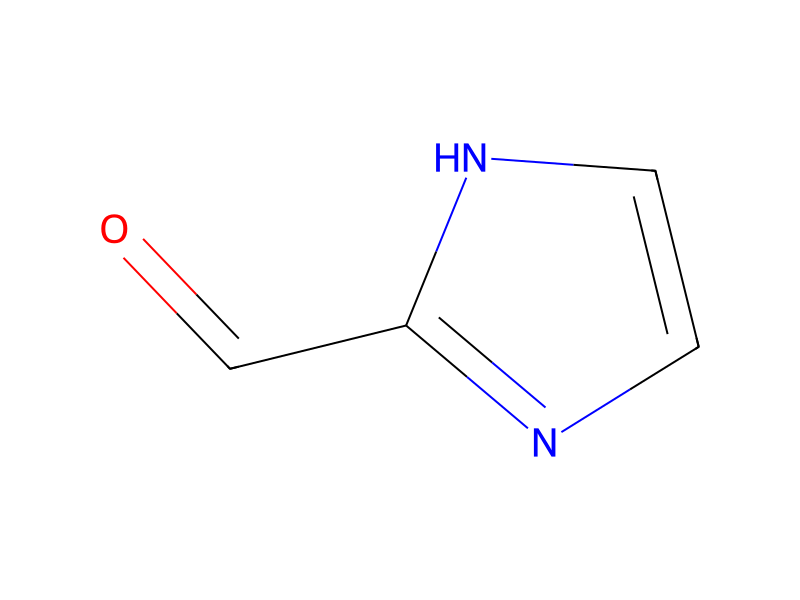




Procedure
1.5 g of 2-imidazole carboxaldehyde was dissolved in 20 ml of dimethylformamide, 2.18 ml of triethylamine and 4.3 g of triphenylmethyl chloride were added to the above solution, and then the resulting mixture was stirred at room temperature for 24 hours. A saturated sodium bicarbonate aqueous solution and chloroform were added to the reaction solution, and the resulting organic layer was collected, washed with a saturated aqueous sodium chloride solution and then dried over anhydrous sodium sulfate, followed by evaporation of the solvent. The residue was subjected to silica gel chromatography eluted with dichloromethane-methanol (50:1) to obtain 4.717 g of 1-triphenylmethyl-2-imidazole carboxaldehyde.
Workup
- customthe resulting organic layer was collected
- washwashed with a saturated aqueous sodium chloride solution
- dry with materialdried over anhydrous sodium sulfate
- customfollowed by evaporation of the solvent
- washeluted with dichloromethane-methanol (50:1)
Sources & evidence
- ORD record
- ord-1b3b2f2682394a8f9136632e93d4d9ac
- Source dataset
- uspto-grants-1996_10
- Patent number
- US05565479
Reaction notes
Loading…