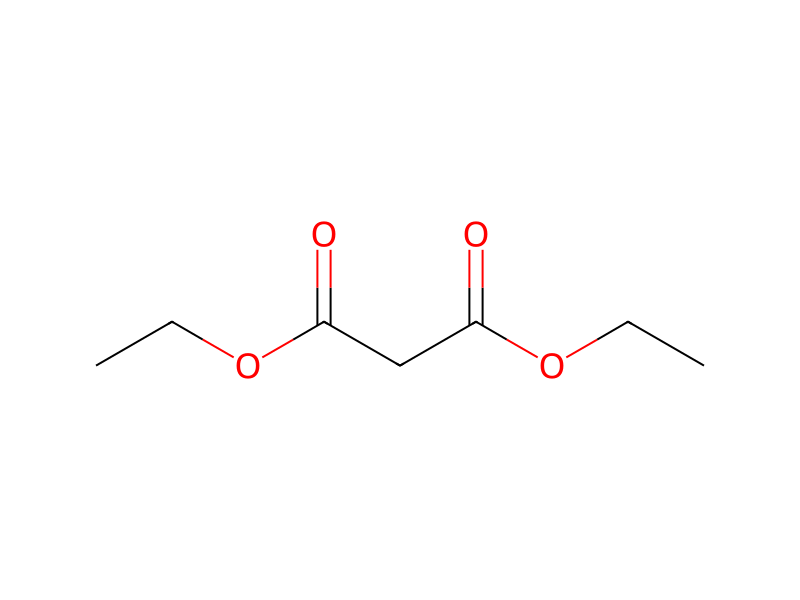
Diethyl Malonate → HCID 21287874, compound
Reaction equation

[H-].[Na+].[C:3]([O:11][CH2:12][CH3:13])(=[O:10])[CH2:4][C:5]([O:7][CH2:8][CH3:9])=[O:6].Br[CH2:15][CH2:16][CH2:17][CH2:18][CH2:19][CH2:20][C:21]#[N:22].S([O-])(O)(=O)=O.[K+]>CN(C)C=O.O.C(OCC)(=O)C>[C:21]([CH2:20][CH2:19][CH2:18][CH2:17][CH2:16][CH2:15][CH:4]([C:5]([O:7][CH2:8][CH3:9])=[O:6])[C:3]([O:11][CH2:12][CH3:13])=[O:10])#[N:22]Participants






Procedure
2.3 g of sodium hydride (as a 55% w/w dispersion in mineral oil) were gradually added with ice cooling to a solution of 8.0 ml of diethyl malonate dissolved in 80 ml of dimethylformamide. The mixture was stirred for 30 minutes, and then 10 g of 7-bromoheptanenitrile were added dropwise to it over a period of 30 minutes. The mixture was then stirred at room temperature for 20 hours in an atmosphere of nitrogen. At the end of this time, ethyl acetate and water were added to the mixture, which was then acidified by adding an aqueous solution of potassium hydrogen sulfate, after which the organic layer was separated. This layer was dried over anhydrous magnesium sulfate and the solvent was removed by evaporation under reduced pressure. The residue was purified by column chromatography through silica gel (eluent: a 3:1 by volume mixture of cyclohexane and ethyl acetate) to afford 8.9 g of the title compound as a liquid.
Workup
- stirringThe mixture was then stirred at room temperature for 20 hours in an atmosphere of nitrogen
- customafter which the organic layer was separated
- dry with materialThis layer was dried over anhydrous magnesium sulfate
- customthe solvent was removed by evaporation under reduced pressure
- customThe residue was purified by column chromatography through silica gel (eluent
- additiona 3:1 by volume mixture of cyclohexane and ethyl acetate)
Sources & evidence
- ORD record
- ord-cbdff99f412346f1a3b4b00a946cec57
- Source dataset
- uspto-grants-1988_10
- Patent number
- US04778790
Reaction notes
Loading…