Pyridine → HCID 59455903, compound
Reaction equation

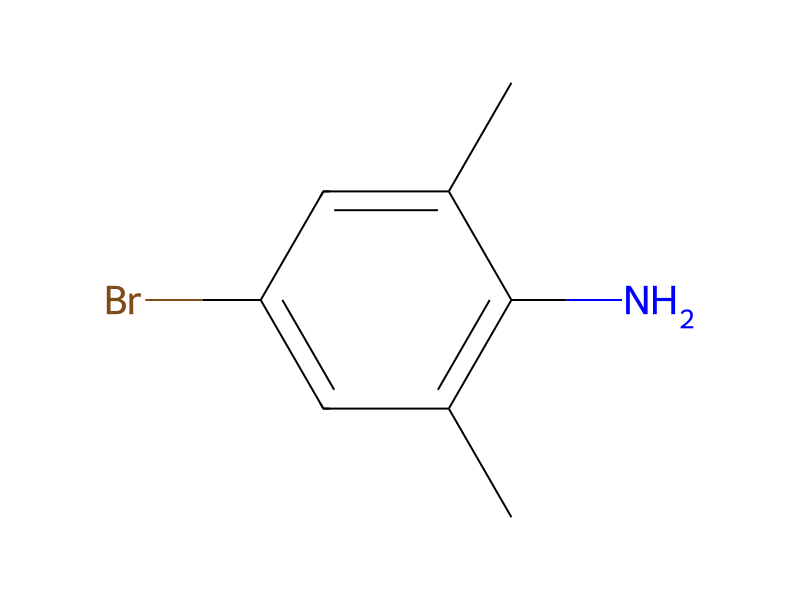
[Br:1][C:2]1[CH:8]=[C:7]([CH3:9])[C:5]([NH2:6])=[C:4]([CH3:10])[CH:3]=1.N1C=CC=CC=1.[F:17][C:18]1[CH:26]=[CH:25][C:21]([C:22](Cl)=[O:23])=[CH:20][C:19]=1[N+:27]([O-:29])=[O:28]>O1CCCC1.C(OCC)(=O)C.C(=O)([O-])O.[Na+]>[Br:1][C:2]1[CH:8]=[C:7]([CH3:9])[C:5]([NH:6][C:22](=[O:23])[C:21]2[CH:25]=[CH:26][C:18]([F:17])=[C:19]([N+:27]([O-:29])=[O:28])[CH:20]=2)=[C:4]([CH3:10])[CH:3]=1Participants






Procedure
To a mixture of 4-bromo-2,6-dimethylaniline (15 g, 75 mmol) (commercially available) and pyridine (16.1 ml, 200 mmol) in anhydrous tetrahydrofuran (150 ml) under an atmosphere of nitrogen was added the solution of 4-fluoro-3-nitrobenzoyl chloride (Step A). The reaction mixture was stirred at ambient temperature for 8 hours. The reaction mixture was diluted with ethyl acetate and aqueous sodium hydrogen carbonate (saturated). The phases were separated and the aqueous phase was extracted twice with ethyl acetate. The combined organic phases were dried over sodium sulfate and concentrated. The residue was purified by column chromatography on silica gel (eluent: cyclohexane/ethyl acetate 2:1) to give N-(4-bromo-2,6-dimethyl-phenyl)-4-fluoro-3-nitro-benzamide (27.54 g, 67% yield) which was used without further purification. LC/MS (Method A): 369 (MH+), 410 (MH++CH3CN).
Workup
- customThe phases were separated
- extractionthe aqueous phase was extracted twice with ethyl acetate
- dry with materialThe combined organic phases were dried over sodium sulfate
- concentrationconcentrated
- customThe residue was purified by column chromatography on silica gel (eluent: cyclohexane/ethyl acetate 2:1)
Sources & evidence
- ORD record
- ord-653fb6dbe5a74bee827d257080b147c7
- Source dataset
- uspto-grants-2012_08
- Patent number
- US08236828B2
Reaction notes
Loading…