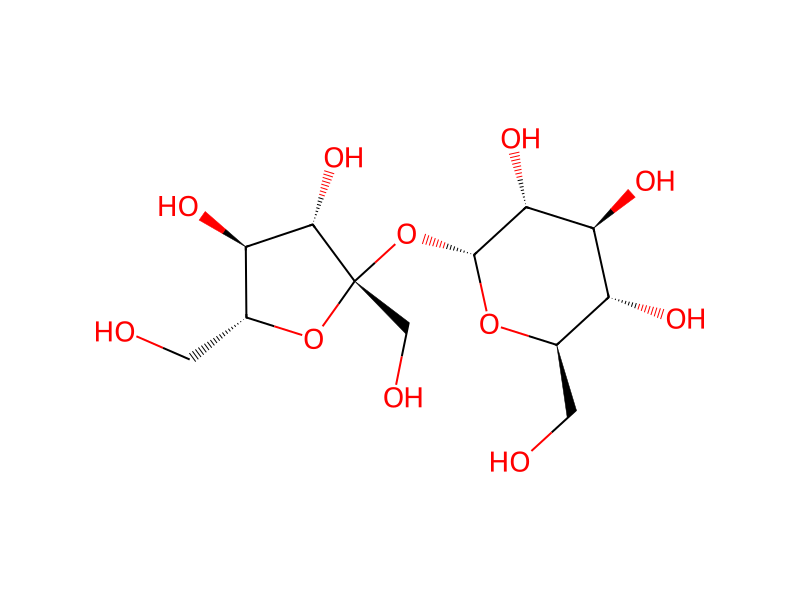
Sucrose → HCID 71752857, compound
Reaction equation

[CH2:1]([OH:23])[C@H:2]1[O:7][C@H:6]([O:8][C@:9]2([CH2:18][OH:19])[O:13][C@H:12]([CH2:14][OH:15])[C@@H:11]([OH:16])[C@@H:10]2[OH:17])[C@H:5]([OH:20])[C@@H:4]([OH:21])[C@@H:3]1[OH:22].C(N([CH2:29][CH3:30])CC)C.[C:31](Cl)([C:44]1[CH:49]=[CH:48][CH:47]=[CH:46][CH:45]=1)([C:38]1[CH:43]=[CH:42][CH:41]=[CH:40][CH:39]=1)[C:32]1[CH:37]=[CH:36][CH:35]=[CH:34][CH:33]=1.C(Cl)Cl>CN(C)C=O>[CH:35]1[CH:36]=[CH:37][C:32]([C:31]([O:23][CH2:1][C@H:2]2[O:7][CH:6]([O:8][C@:9]3([CH2:18][O:19][C:31]([C:30]4[CH:29]=[CH:49][CH:44]=[CH:45][CH:46]=4)([C:32]4[CH:37]=[CH:36][CH:35]=[CH:34][CH:33]=4)[C:38]4[CH:43]=[CH:42][CH:41]=[CH:40][CH:39]=4)[O:13][C@H:12]([CH2:14][O:15][C:31]([C:38]4[CH:39]=[CH:40][CH:41]=[CH:42][CH:43]=4)([C:32]4[CH:33]=[CH:34][CH:35]=[CH:36][CH:37]=4)[C:44]4[CH:49]=[CH:48][CH:47]=[CH:46][CH:45]=4)[C@@H:11]([OH:16])[C@@H:10]3[OH:17])[C@H:5]([OH:20])[C@@H:4]([OH:21])[C@H:3]2[OH:22])([C:44]2[CH:49]=[CH:48][CH:47]=[CH:46][CH:45]=2)[C:38]2[CH:43]=[CH:42][CH:41]=[CH:40][CH:39]=2)=[CH:33][CH:34]=1Participants
Reactant 4



Product 1

Reagents, catalysts & solvents 1

Conditions
- Temperature
- 50 °C
Procedure
In a dry 5-L four-neck flask is dissolved 70 grams of sucrose (204.5 mmol) in 1 liter dry dimethylformamide (DMF) and dry triethylamine (200 ml, 145 grams, 1,423 mmol). The solution is allowed to attain a temperature of 25° to 30° C. and treated with a solution of trityl chloride (260 grams, 935.2 mmol, 4.5 equiv.) in dimethylformamide (600 ml), added dropwise over 1 hour. After the addition is complete, the reaction mixture is heated to a temperature of 50° C. and allowed to stir for 48 hours at that temperature. After 2 days, the reaction mixture is filtered through a short pad of silica gel to remove the precipitated triethylammonium hydrochloride and the residue is washed with methylene chloride:acetone (4:1). The effluent is then concentrated to a residue, which is reconstituted in methylene chloride and washed successively with 1 N hydrochloric acid, saturated sodium bicarbonate solution, water, and brine and then dried over anhydrous sodium sulfate. The dry organic extract is then filtered and concentrated in vacuo to provide a yellow foamy solid. This material is then applied on a silica gel column (230 to 400 mesh, 10 cm ×50 cm) packed with methylene chloride and successively eluted with methylene chloride, then 10% acetone in methylene chloride, followed by elution with 20% acetone in methylene chloride. The desired tri-O-tritylsucrose elutes with 20% acetone in methylene chloride and has an Rf of 0.21 in the same solvent. The amount of 1',6,6'-tri-O-tritylsucrose obtained by this method of synthesis and isolation is typically between 146 to 150 grams or 67% to 68.8%. On scales between 1 mmol and 50 mmol (314 mg to 15.7 grams) yields average about 76%.
Workup
- customa temperature of 25° to 30° C.
- additionadded dropwise over 1 hour
- additionAfter the addition
- waitAfter 2 days
- filtrationthe reaction mixture is filtered through a short pad of silica gel
- customto remove the precipitated triethylammonium hydrochloride
- washthe residue is washed with methylene chloride:acetone (4:1)
- concentrationThe effluent is then concentrated to a residue, which
- washwashed successively with 1 N hydrochloric acid, saturated sodium bicarbonate solution, water, and brine
- dry with materialdried over anhydrous sodium sulfate
- extractionThe dry organic extract
- filtrationis then filtered
- concentrationconcentrated in vacuo
- customto provide a yellow foamy solid
- washsuccessively eluted with methylene chloride
- wash10% acetone in methylene chloride, followed by elution with 20% acetone in methylene chloride
Sources & evidence
- ORD record
- ord-b3dd4d5541934067a7a046b88f9ed94f
- Source dataset
- uspto-grants-1992_06
- Patent number
- US05120836
Reaction notes
Loading…