Acetyl chloride → Indole, 3-acetyl-5-nitro-
Reaction equation

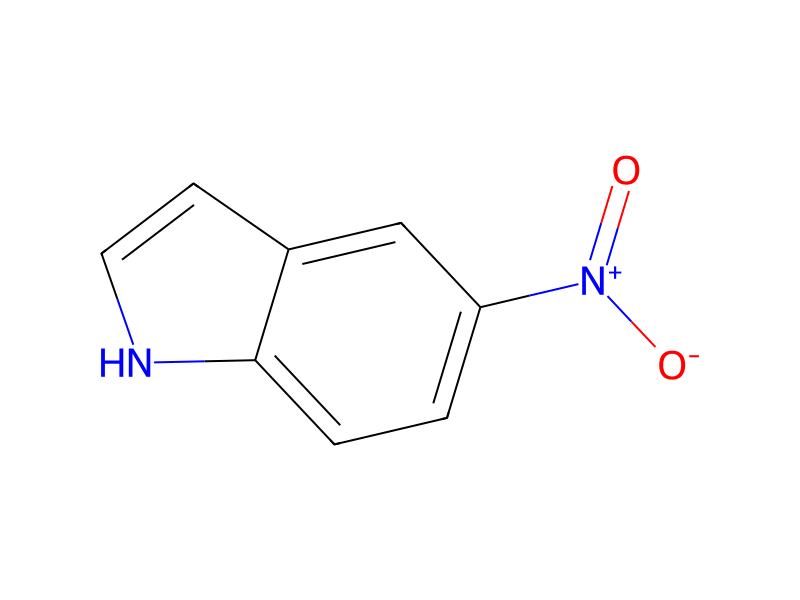
[N+:1]([C:4]1[CH:5]=[C:6]2[C:10](=[CH:11][CH:12]=1)[NH:9][CH:8]=[CH:7]2)([O-:3])=[O:2].[C:13](Cl)(=[O:15])[CH3:14].[Sn](Cl)(Cl)(Cl)Cl.C([O-])(O)=O.[Na+]>C(Cl)Cl.CN(C=O)C>[C:13]([C:7]1[C:6]2[C:10](=[CH:11][CH:12]=[C:4]([N+:1]([O-:3])=[O:2])[CH:5]=2)[NH:9][CH:8]=1)(=[O:15])[CH3:14]Participants
7






Procedure
A solution of 5-nitroindole (10 g, 61.6 mmol) and acetyl chloride (5.8 g, 74 mmol) in methylene chloride at 0° C. is treated with tin tetrachloride (1M in CH2Cl2, 68 mL), stirred under N2 for 6 h, treated with saturated NaHCO3 to pH 9 and filtered. The filtrate is concentrated in vacuo to give a residue. The residue is dissolved in DMF and filtered. This filtrate is concentrated in vacuo to give the title product, 12.6 g (99% yield), identified by NMR and mass spectral analyses.
Workup
- filtrationfiltered
- concentrationThe filtrate is concentrated in vacuo
- customto give a residue
- filtrationfiltered
- concentrationThis filtrate is concentrated in vacuo
Sources & evidence
- ORD record
- ord-a82ae2ec0e2041e38687d86285c1a88c
- Source dataset
- uspto-grants-2005_10
- Patent number
- US06951881B2
Reaction notes
Loading…