HomeMCPWorkbenchSkills
HomeWorkbenchNotificationsMe
llms.txt · MCP GuidePrivacy Policy · Terms of Service · Supportv1.8.3
  1. Home
  2. /Reaction

Hydrochloric Acid → N-ethyl-1H-pyrazole-1-carboxamide

HRID 1068384
Print

Reaction equation

HRID 1068384 reaction equation
[NH:1]1[CH:5]=[CH:4][CH:3]=[N:2]1.C(N(CC)CC)C.[CH2:13]([N:15]=[C:16]=[O:17])[CH3:14].Cl>C1COCC1.C(OCC)(=O)C>[CH2:13]([NH:15][C:16]([N:1]1[CH:5]=[CH:4][CH:3]=[N:2]1)=[O:17])[CH3:14]
ParticipantsProcedureWorkupSources & evidenceReaction notes

Participants

7

Reactant 4

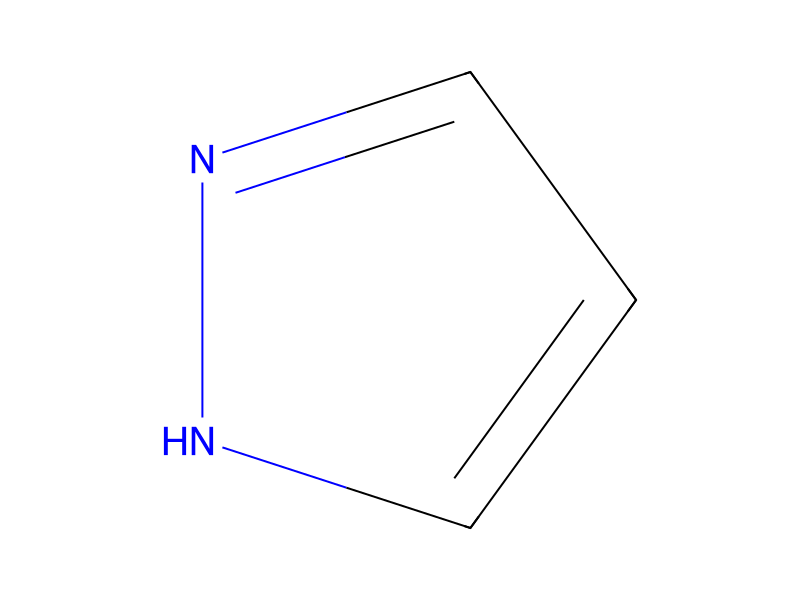
HCID 313Hydrochloric AcidHCID 1048PyrazoleHCID 8022Ethyl isocyanateHCID 8471Triethylamine

Product 1

HCID 18630148N-ethyl-1H-pyrazole-1-carboxamideYield 71.9%

Reagents, catalysts & solvents 2

HCID 8028Tetrahydrofuran
Solvent
HCID 8857Ethyl AcetateSolvent

Procedure

To a solution of pyrazole (1.7 g, 25 mmol) and 4 mL triethylamine in 50 mL dry THF was added ethyl isocyanate (2 g, 28 mmol) at 0° C. and the resulting reaction solution was stirred at RT for 18 h. Ethyl acetate and 2N HCl were added. The aq layer was separated and extracted with ethyl acetate. The combined ethyl acetate layers were washed with brine, dried and concentrated in vacuo to give an oil. The oil was triturated with cold hexane to give 2.5 g of N-ethyl-1H-pyrazole-1-carboxamide as a white solid.

Workup

  1. customthe resulting reaction solution
  2. customThe aq layer was separated
  3. extractionextracted with ethyl acetate
  4. washThe combined ethyl acetate layers were washed with brine
  5. customdried
  6. concentrationconcentrated in vacuo
  7. customto give an oil
  8. customThe oil was triturated with cold hexane

Sources & evidence

ORD record
ord-15e4a878ce60427499fa093f421d33f1
Source dataset
uspto-grants-2001_06
DOI
10.6084/m9.figshare.5104873.v1
Patent number
US06248894B1

Reaction notes

On this pageParticipantsProcedureWorkupSources & evidenceReaction notes