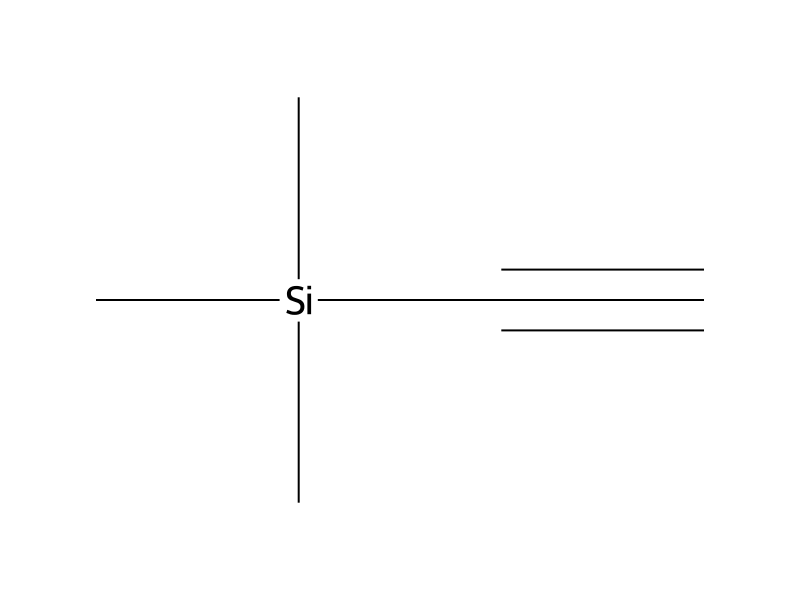
Cl[C:2]1[CH:3]=[C:4]2[C:9](=[CH:10][N:11]=1)[N:8]=[CH:7][C:6]([C:12]#[N:13])=[C:5]2[OH:14].C1(P(C2C=CC=CC=2)C2C=CC=CC=2)C=CC=CC=1.[CH3:34][Si:35]([C:38]#[CH:39])([CH3:37])[CH3:36]>CN(C)C=O.C(N(CC)CC)C.C([O-])(=O)C.[Pd+2].C([O-])(=O)C>[OH:14][C:5]1[C:4]2[C:9](=[CH:10][N:11]=[C:2]([C:39]#[C:38][Si:35]([CH3:37])([CH3:36])[CH3:34])[CH:3]=2)[N:8]=[CH:7][C:6]=1[C:12]#[N:13]To 1 g of 6-chloro-4-hydroxy-[1,7]naphthyridine-3-carbonitrile in 5 mL each dimethyl formamide and triethyl amine was added 1 g triphenyl phosphine, 7 mL of trimethylsilanylethyne, and 225 mg of palladium (II) acetate. The reaction was heated at 120° C. for 18 hours, stripped of solvent, and purified by flash chromatography on silica gel with a methanol/chloroform gradient. Recrystallization from ethanol containing a small amount of water yielded 690 mg of 4-hydroxy-6-trimethylsilanylethynyl-[1,7]naphthyridine-3-carbonitrile: melting point 307° C. (decomposed); mass spectrum (m/e): M+H 268.0.