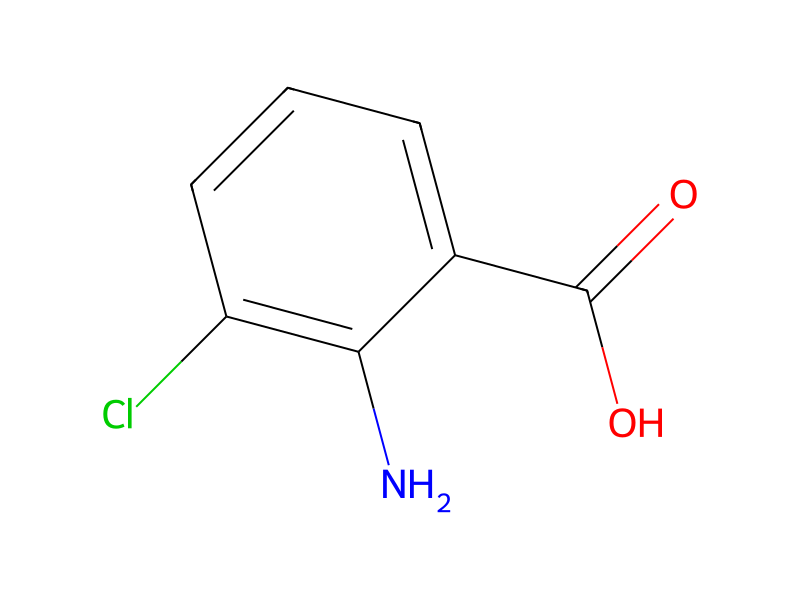
To a solution of 3.82 g of 6-azabicyclo[3,2,1]-octan-7-one (R. L. Augustine and L. A. Bag, J. Org. Chem., 40:1074 (1975)) in 25 mL of chloroform was added 4 mL of phosphorus oxychloride. After the mildly exothermic reaction ceased, the mixture was stirred at room temperature for 4 hours. 6.3 g of 4,6-dichloroanthranilic acid (prepared from the corresponding isatine: T. Sandmeyer, Helv. Chim. Acta, 2:234 (1919), by oxidation with alkaline hydrogen peroxide, following the procedure described by Baker, et al., J. Org. Chem., 17:141 (1952) for the synthesis of 3-chloroanthranilic acid) was dissolved in a mixture of 50 mL of chloroform and 10 mL of triethylamine. This solution was added to the stirred above solution of the imidoyl chloride at such a rate as to prevent boiling over (exothermic!), approximately 2 minutes. Then the mixture was stirred at room temperature for 4 hours and then refluxed for 3 days. Then the dark brown mixture was treated with 200 mL of 10% aqueous K2CO3. The chloroform layer was separated, aqueous layer was extracted two times with 50 mL of chloroform. The combined chloroform extract was dried with anhydrous potassium carbonate, filtered, and concentrated in vacuo. The residue was chromatographed on silica gel, using 8:1 chloroform-ethyl acetate as eluent. The corresponding fractions were concentrated in vacuo, giving a crystalline solid. This was recrystallized from ethyl acetate-hexane, giving colorless crystals.