HomeMCPWorkbenchSkills
HomeWorkbenchNotificationsMe
llms.txt · MCP GuidePrivacy Policy · Terms of Service · Supportv1.8.3
  1. Home
  2. /Reaction

Hydrogen Peroxide → 3-(3-Hydroxypropyl)-1-(2-methyl-4-nitrophenyl)pyridin-2(1H)-one

HRID 391742
Print

Reaction equation

HRID 391742 reaction equation
C12BC(CCC1)CCC2.[CH2:10]([C:13]1[C:14](=[O:29])[N:15]([C:19]2[CH:24]=[CH:23][C:22]([N+:25]([O-:27])=[O:26])=[CH:21][C:20]=2[CH3:28])[CH:16]=[CH:17][CH:18]=1)[CH:11]=[CH2:12].[OH-].[Na+].OO.S(=O)(O)[O-:35].[Na+]>C1COCC1.O.C(OCC)(=O)C>[OH:35][CH2:12][CH2:11][CH2:10][C:13]1[C:14](=[O:29])[N:15]([C:19]2[CH:24]=[CH:23][C:22]([N+:25]([O-:27])=[O:26])=[CH:21][C:20]=2[CH3:28])[CH:16]=[CH:17][CH:18]=1
ParticipantsConditionsProcedureWorkupSources & evidenceReaction notes

Participants

9

Reactant 5

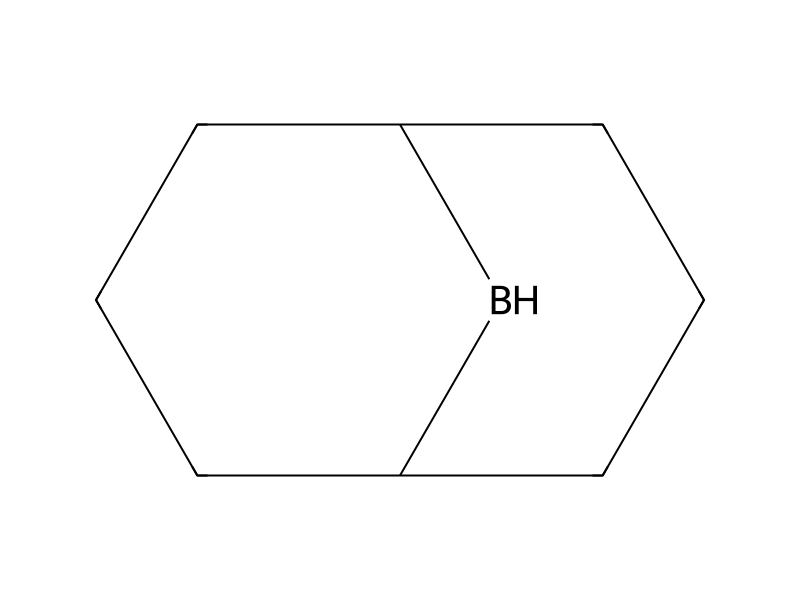
HCID 784Hydrogen PeroxideHCID 14798Sodium HydroxideHCID 789669-Borabicyclo(3.3.1)nonaneHCID 23665763Sodium BisulfiteHCID 594101353-Allyl-1-(2-methyl-4-nitrophenyl)pyridin-2(1H)-one

Product 1

HCID 594101913-(3-Hydroxypropyl)-1-(2-methyl-4-nitrophenyl)pyridin-2(1H)-one

Reagents, catalysts & solvents 3

HCID 962WaterSolventHCID 8028TetrahydrofuranSolvent2×HCID 8857Ethyl AcetateSolvent

Conditions

Temperature
0 °C

Procedure

At 0° C., 18.5 ml (9.25 mmol) of a 0.5 molar solution of 9-borabicyclo[3.3.1]nonane in THF are slowly added dropwise to 1.00 g (3.70 mmol) of the compound from Example 35A in 4 ml THF. After one hour at room temperature, the mixture is again cooled to 0° C., and 18.5 ml (18.5 mmol) of a 1 molar solution of sodium hydroxide in water are added dropwise. The mixture is stirred at 0° C. for a further 30 min, and 3.24 ml of a 30% strength hydrogen peroxide solution are then added such that the temperature does not exceed 30° C. The mixture is stirred with ice-cooling for 30 min, and ethyl acetate and then 11 g (40 mmol) of sodium bisulphite solution are then added. The organic phase is separated off, and the aqueous phase is extracted twice with ethyl acetate. The combined organic phases are washed with saturated aqueous sodium chloride solution. The organic phase is dried over sodium sulphate and then evaporated to dryness under reduced pressure. The residue is chromatographed on silica gel (cyclohexane/ethyl acetate 1:4). This gives 1.03 g (83% of theory) of the desired product.

Workup

  1. customdoes not exceed 30° C
  2. stirringThe mixture is stirred with ice-
  3. temperaturecooling for 30 min
  4. customThe organic phase is separated off
  5. extractionthe aqueous phase is extracted twice with ethyl acetate
  6. washThe combined organic phases are washed with saturated aqueous sodium chloride solution
  7. dry with materialThe organic phase is dried over sodium sulphate
  8. customevaporated to dryness under reduced pressure
  9. customThe residue is chromatographed on silica gel (cyclohexane/ethyl acetate 1:4)

Sources & evidence

ORD record
ord-23e78cd9748a465d910d41d890651f9b
Source dataset
uspto-grants-2013_02
DOI
10.6084/m9.figshare.5104873.v1
Patent number
US08383822B2

Reaction notes

On this pageParticipantsConditionsProcedureWorkupSources & evidenceReaction notes