Hydrochloric Acid → HCID 89783296, compound
Reaction equation

C([O:5][C:6]([NH:8][C:9]([C:12]1[NH:13][C:14]([C:22]2[CH:31]=[CH:30][CH:29]=[C:28]3[C:23]=2[N:24]=[C:25]([NH:33][C:34]([CH3:37])([CH3:36])[CH3:35])[C:26]([CH3:32])=[N:27]3)=[CH:15][C:16]=1C(OCC)=O)([CH3:11])[CH3:10])=[O:7])(C)(C)C.Cl.CCN(C(C)C)C(C)C.C1CN([P+](ON2N=NC3C2=CC=CC=3)(N2CCCC2)N2CCCC2)CC1.F[P-](F)(F)(F)(F)F.C([O-])(O)=O.[Na+]>O.CN(C=O)C.O1CCOCC1>[C:6](=[O:7])=[O:5].[C:34]([NH:33][C:25]1[C:26]([CH3:32])=[N:27][C:28]2[C:23]([N:24]=1)=[C:22]([C:14]1[NH:13][C:12]3[C:9]([CH3:11])([CH3:10])[NH:8][C:6](=[O:5])[C:16]=3[CH:15]=1)[CH:31]=[CH:30][CH:29]=2)([CH3:37])([CH3:36])[CH3:35]Participants
Reactant 5




Product 2


Reagents, catalysts & solvents 3



Conditions
- Temperature
- 110 °C
Procedure
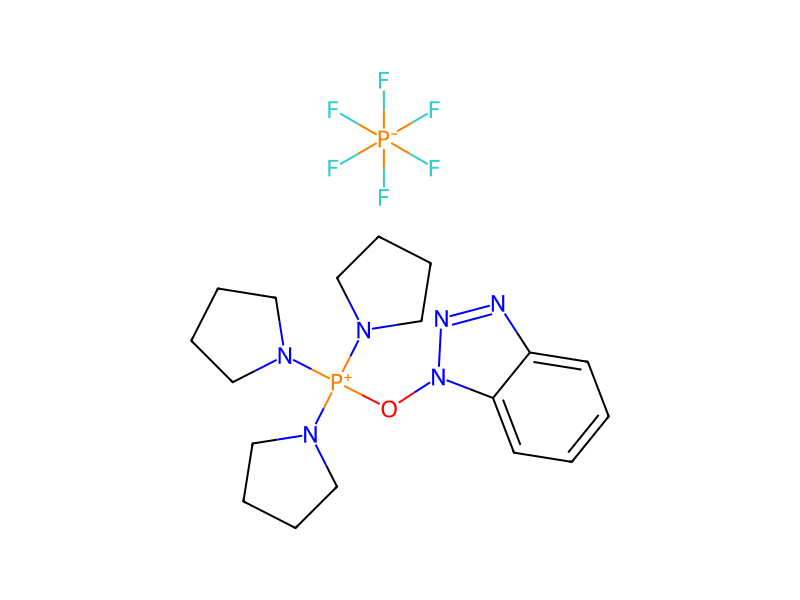
To a 10-20 mL Personal Chemistry microwave vial was added ethyl 2-(2-((tert-butoxycarbonyl)amino)propan-2-yl)-5-(3-(tert-butylamino)-2-methylquinoxalin-5-yl)-1H-pyrrole-3-carboxylate (466c) (0.37 g, 0.73 mmol), 1,4-dioxane (5 mL), water (5 mL), and finally LiOH monohydrate (Fluka Chemie) (0.154 g, 3.66 mmol). The mixture was stirred and heated at 110° C. for 1 h in the microwave. The solution was diluted with water (20 mL) and then lyophilized. The resulting solid was treated with 1,4-dioxane (4 mL) and then a solution of 4 M HCl in 1,4-dioxane (Sigma-Aldrich) (2.5 mL, 10.0 mmol). The reaction was stirred for 2 h at RT and then concentrated. The resulting material was dissolved in DCM (4 mL) and DMF (4.00 mL) and then treated with DIPEA (0.38 mL, 2.19 mmol) and ((1H-benzo[d][1,2,3]triazol-1-yl)oxy)tri(pyrrolidin-1-yl)phosphonium hexafluorophosphate(V) (PyBop, Matrix Innovation) (0.418 g, 0.803 mmol). The solution was stirred at RT for 1 h. The reaction mixture was treated with sat NaHCO3 (50 mL) and extracted with EtOAc (3×50 mL). The combined extracts were washed with water (3×100 mL). The extracts were diluted with hexane (50 mL) and washed again with water (5×100 mL) and brine (50 mL) and then dried (Na2SO4) and concentrated onto silica. Purification by silica gel chromatography (40 g Silicycle HP column, 0 to 4.0% MeOH/CH2Cl2) followed by SFC purification (column: Princeton SFC Pyridine (250×21 mm, 5 micron), mobile phase: A: CO2, B: MeOH (20 mM NH3), flow rate: 70 mL/min, oven temp: 40° C., outlet pressure: 100 bar) afforded the title compound as a yellow solid (14 mg, 5%). m/z (ESI, +ve ion) 364.1 (M+H)+. 1H NMR (400 MHz, DMSO-d6) δ ppm 11.93 (br. s, 1H), 7.81 (dd, J=7.4, 1.4 Hz, 1H), 7.65 (s, 1H), 7.61 (dd, J=8.0, 1.4 Hz, 1H), 7.34 (t, J=7.7 Hz, 1H), 6.76 (d, J=1.6 Hz, 1H), 6.00 (s, 1H), 2.56 (s, 3H), 1.54 (s, 9H), 1.48 (s, 6H).
Workup
- stirringThe reaction was stirred for 2 h at RT
- concentrationconcentrated
- dissolutionThe resulting material was dissolved in DCM (4 mL)
- stirringThe solution was stirred at RT for 1 h
- extractionextracted with EtOAc (3×50 mL)
- washThe combined extracts were washed with water (3×100 mL)
- additionThe extracts were diluted with hexane (50 mL)
- washwashed again with water (5×100 mL) and brine (50 mL)
- dry with materialdried (Na2SO4)
- concentrationconcentrated onto silica
- customPurification by silica gel chromatography (40 g Silicycle HP column, 0 to 4.0% MeOH/CH2Cl2)
- customfollowed by SFC purification (column
Sources & evidence
- ORD record
- ord-dad3370a3b0142cca391b88c72965562
- Source dataset
- uspto-grants-2016_07
- Patent number
- US09394297B2
Reaction notes
Loading…