Methyl Acrylate → HCID 13598799, compound
Reaction equation

Br[C:2]1[CH:3]=[CH:4][CH:5]=[C:6]2[C:10]=1[NH:9][CH:8]=[CH:7]2.[C:11]([O:15][CH3:16])(=[O:14])[CH:12]=[CH2:13].C1(P(C2C=CC=CC=2)C2C=CC=CC=2)C=CC=CC=1.C(N(CC)C(C)C)(C)C>C([O-])(=O)C.[Pd+2].C([O-])(=O)C.CN(C)C=O>[NH:9]1[C:10]2[C:6](=[CH:5][CH:4]=[CH:3][C:2]=2/[CH:13]=[CH:12]/[C:11]([O:15][CH3:16])=[O:14])[CH:7]=[CH:8]1Participants



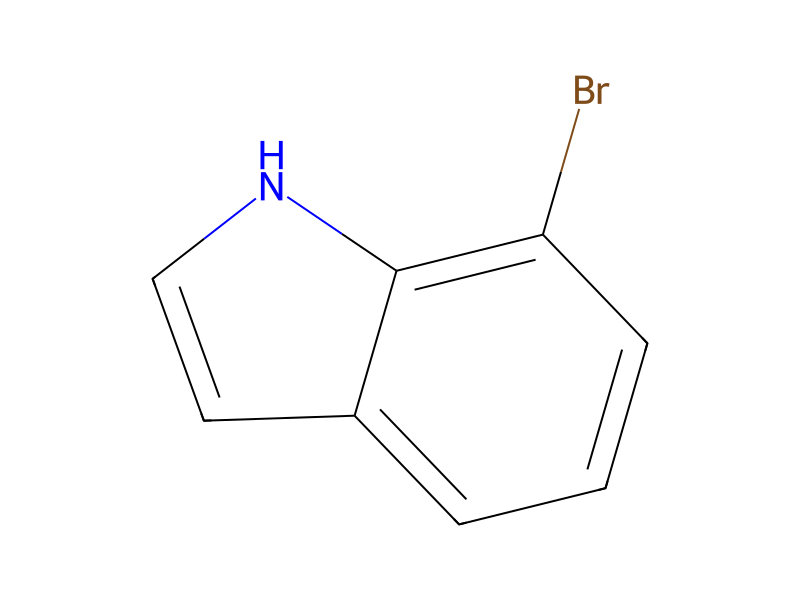



Conditions
- Temperature
- 70 °C
Procedure
7-Bromoindole (5.0 g, 25.5 mmol), methyl acrylate (4.6 ml, 51.1 mmol), triphenylphosphine (0.55 g, 2.10 mmol), N,N-diisopropylethylamine (5.8 ml, 42.3 mmol), and palladium (II) acetate (0.25 g, 1.11 mmol) were added to N,N-dimethylformamide (50 ml), and the mixture was stirred at 70° C. for 18 hours under a stream of nitrogen. After cooling to room temperature, methyl acrylate (4.6 ml, 51.1 mmol), triphenylphosphine (0.55 g, 2.10 mmol), and palladium (II) acetate (0.25 g, 1.11 mmol) were added to the reaction mixture, and the mixture was stirred at 75° C. for 47 hours under a stream of nitrogen. After cooling to room temperature, methyl acrylate (7.0 ml, 77.7 mmol), triphenylphosphine (0.88 g, 3.36 mmol), and palladium (II) acetate (0.40 g, 1.78 mmol) were added to the reaction mixture, and the mixture was stirred at 100° C. for 95 hours under a stream of nitrogen. After cooling to room temperature, the reaction mixture was concentrated under reduced pressure. To the obtained residue, a hexane/ethyl acetate mixed solution (1:1, 300 ml) was added, and the organic layer was washed with water. The obtained aqueous layer was subjected to extraction with a hexane/ethyl acetate (1:1) mixed solution, and the combined organic layer was washed with saturated saline. The obtained organic layer was dried over anhydrous magnesium sulfate and then concentrated under reduced pressure. The obtained residue was purified by silica gel chromatography (eluent; hexane:ethyl acetate=6:1) to obtain 2 (E)-methyl 3-(1H-indol-7-yl)acrylate (3.46 g, 67%) as a pale yellow-brown solid. ESI-MS: m/z 202 [M+H]+. 1H-NMR (CDCl3) δ: 3.85 (3H, s), 6.52 (1H, d, J=16.0 Hz), 6.62 (1H, dd, J=2.9, 2.0 Hz), 7.16 (1H, t, J=7.6 Hz), 7.28 (1H, t, J=2.9 Hz), 7.43 (1H, d, J=7.6 Hz), 7.71 (1H, d, J=7.6 Hz), 8.04 (1H, d, J=16.0 Hz), 8.59 (1H, br s).
Workup
- temperatureAfter cooling to room temperature
- stirringthe mixture was stirred at 75° C. for 47 hours under a stream of nitrogen
- temperatureAfter cooling to room temperature
- stirringthe mixture was stirred at 100° C. for 95 hours under a stream of nitrogen
- temperatureAfter cooling to room temperature
- concentrationthe reaction mixture was concentrated under reduced pressure
- additionTo the obtained residue, a hexane/ethyl acetate mixed solution (1:1, 300 ml) was added
- washthe organic layer was washed with water
- extractionThe obtained aqueous layer was subjected to extraction with a hexane/ethyl acetate (1:1)
- additionmixed solution
- washthe combined organic layer was washed with saturated saline
- dry with materialThe obtained organic layer was dried over anhydrous magnesium sulfate
- concentrationconcentrated under reduced pressure
- customThe obtained residue was purified by silica gel chromatography (eluent; hexane:ethyl acetate=6:1)
Sources & evidence
- ORD record
- ord-d355fb25ef4b42a8b55df0ae0380cbc5
- Source dataset
- uspto-grants-2013_06
- Patent number
- US08470786B2
Reaction notes
Loading…