Tetralin → 1,2,3,4-Tetrahydroisoquinoline
Reaction equation

[CH:1]1[C:10]2[C:5](=[CH:6][CH:7]=[CH:8][CH:9]=2)[CH2:4][CH2:3][N:2]=1.O=P12OP3(OP(OP(O3)(O1)=O)(=O)O2)=O.P(Cl)(Cl)(Cl)=O.P(Cl)(Cl)(Cl)(Cl)Cl.C1C2C(=CC=CC=2)CCC1.[BH4-].[Na+].[H][H]>[Pd].[Pt].Cl.[Cl-].[Zn+2].[Cl-].C1(C)C(C)=CC=CC=1.C1(C)C=CC=CC=1>[CH2:1]1[C:10]2[C:5](=[CH:6][CH:7]=[CH:8][CH:9]=2)[CH2:4][CH2:3][NH:2]1Participants
Reactant 7




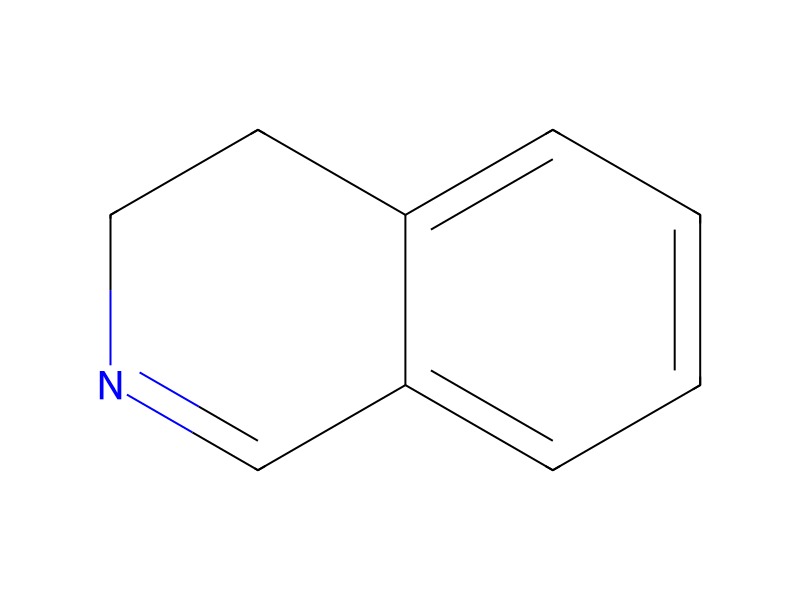


Product 1

Reagents, catalysts & solvents 6






Procedure
may be prepared by the cyclodehydration of the appropriately substituted β-phenethylamide to the corresponding 3,4-dihydroisoquinoline by heating the aforesaid amide in the presence of such dehydrating agents as phosphorus pentoxide, anhydrous zinc chloride, phosphorus oxychloride or phosphorus pentachloride, usually in an inert organic solvent like toluene, xylene or tetralin, followed by reduction in the usual manner, e.g., with sodium borohydride or with hydrogen and palladium-on-charcoal catalyst (the Bischler-Napieralski route); by condensation between the appropriately substituted benzaldehyde and 2-amino-acetaldehyde dialkyl acetal, followed by reduction of the Schiff base product, e.g., with hydrogen and platinum catalyst, and then hydrolysis/ring closure of the resulting N-benzylamino acetaldehyde dialkyl acetal in 6N hydrochloric acid solution, followed by selective reduction of the ring, e.g., with hydrogen and palladium-on-charcoal catalyst, to give the appropriate 1,2,3,4-tetrahydro-isoquinoline [Bobbitt et al., Journal of Organic Chemistry, Vol. 30, p. 2247 (1965), and Bobbitt and Sih, ibid., Vol. 33, p. 856 (1968)].
Sources & evidence
- ORD record
- ord-fb57b846d1a047109923bf3c03a74d0c
- Source dataset
- uspto-grants-1976_06
- Patent number
- US03960861
Reaction notes
Loading…