4-Hydroxybenzaldehyde → 4-((2-Methyl-2-propyl)diphenylsilyloxy)benzaldehyde
Reaction equation

[C:1]([Si:5]([C:13]1[CH:18]=[CH:17][CH:16]=[CH:15][CH:14]=1)([C:7]1[CH:12]=[CH:11][CH:10]=[CH:9][CH:8]=1)Cl)([CH3:4])([CH3:3])[CH3:2].[OH:19][C:20]1[CH:27]=[CH:26][C:23]([CH:24]=[O:25])=[CH:22][CH:21]=1.CCN(CC)CC>ClCCCl>[CH3:2][C:1]([Si:5]([C:13]1[CH:18]=[CH:17][CH:16]=[CH:15][CH:14]=1)([C:7]1[CH:12]=[CH:11][CH:10]=[CH:9][CH:8]=1)[O:19][C:20]1[CH:27]=[CH:26][C:23]([CH:24]=[O:25])=[CH:22][CH:21]=1)([CH3:4])[CH3:3]Participants
5
Reactant 3


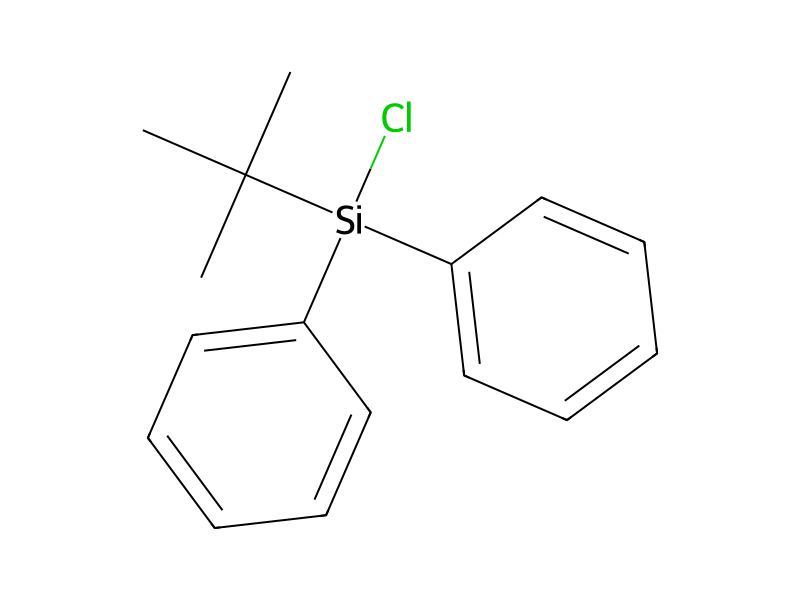
Product 1

Reagents, catalysts & solvents 1

Procedure
At 0° C., tert-butyldiphenylchlorosilane (50 g) was added slowly to a solution of p-hydroxybenzaldehyde (22 g) and Et3N (42 mL) in 1,2-dichloroethane (400 mL) and the mixture was stirred at room temperature a few hours. After the usual work up, the product was purified by flash chromatography on silica using EtOAc:hexane 1:10 and was used as such for Step 2.
Workup
- customAfter the usual work up, the product was purified by flash chromatography on silica
Sources & evidence
- ORD record
- ord-3fadddfa39964ab886d131b58d7a7e72
- Source dataset
- uspto-grants-1993_08
- Patent number
- US05232916
Reaction notes
Loading…