Nitrogen → 5-(3-Chloro-5-nitrophenyl)thiazole
Reaction equation
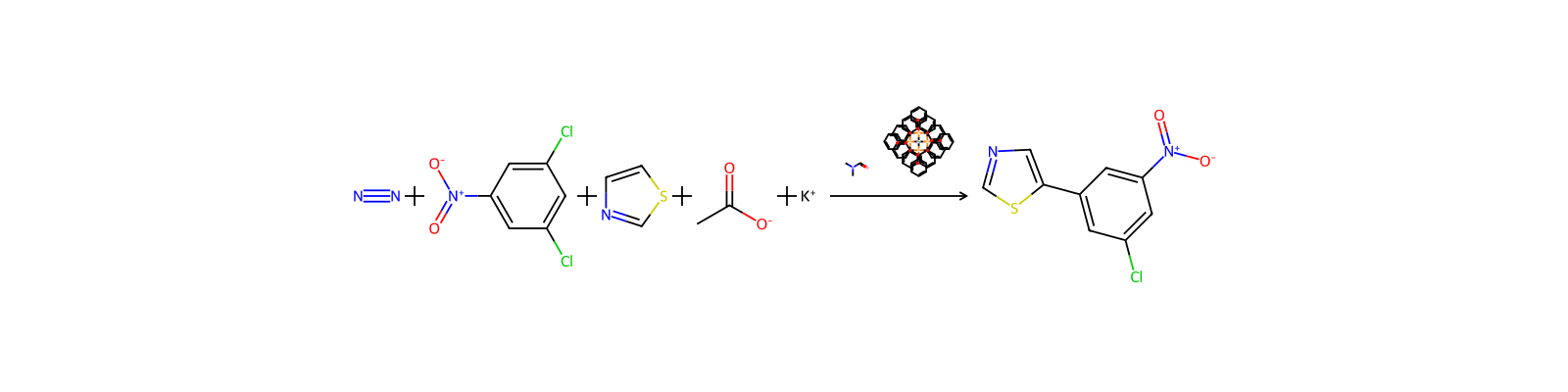
N#N.Cl[C:4]1[CH:5]=[C:6]([N+:11]([O-:13])=[O:12])[CH:7]=[C:8]([Cl:10])[CH:9]=1.[S:14]1[CH:18]=[CH:17][N:16]=[CH:15]1.C([O-])(=O)C.[K+]>CN(C=O)C.C1C=CC([P]([Pd]([P](C2C=CC=CC=2)(C2C=CC=CC=2)C2C=CC=CC=2)([P](C2C=CC=CC=2)(C2C=CC=CC=2)C2C=CC=CC=2)[P](C2C=CC=CC=2)(C2C=CC=CC=2)C2C=CC=CC=2)(C2C=CC=CC=2)C2C=CC=CC=2)=CC=1>[Cl:10][C:8]1[CH:9]=[C:4]([C:18]2[S:14][CH:15]=[N:16][CH:17]=2)[CH:5]=[C:6]([N+:11]([O-:13])=[O:12])[CH:7]=1Participants
7






Conditions
- Temperature
- 120 °C
Procedure
N2 was bubbled through a solution of 3,5-dichloronitrobenzene (0.384 g, 2.00 mmol), thiazole (0.204 g, 2.40 mmol), potassium acetate (0.294 g, 3.00 mmol), and tetrakis(triphenylphosphine)palladium(0) (0.16 g, 0.14 mol) in DMF (5 mL) for 10 min. The mixture was then heated to 120° C. and stirred for 17 h. The solvents were removed in vacuo. The residue was purified by chromatography on silica gel (MeOH in methylene chloride: 1% to 5%) to afford the title compound. 1H-NMR (CDCl3, 400 MHz): δ=7.88 (t, J=2.0 Hz, 1H), 8.20 (t, J=2.4 Hz, 1H), 8.22 (s, 1H), 8.32 (t, J=2.0 Hz, 1H), 8.90 (s, 1H). MS (ES+): m/z 241.04 (35Cl, MH+), 243.00 (37Cl, MH+). HPLC: tR=3.35 min (ZQ2000, polar—5 min).
Workup
- customThe solvents were removed in vacuo
- customThe residue was purified by chromatography on silica gel (MeOH in methylene chloride: 1% to 5%)
Sources & evidence
- ORD record
- ord-d8fac006903b495a88cf4adbf68ec1ed
- Source dataset
- uspto-grants-2008_12
- Patent number
- US07465726B2
Reaction notes
Loading…