Triethylamine → 2,4-Dichloro-5-((trimethylsilyl)ethynyl)pyrimidine
Reaction equation

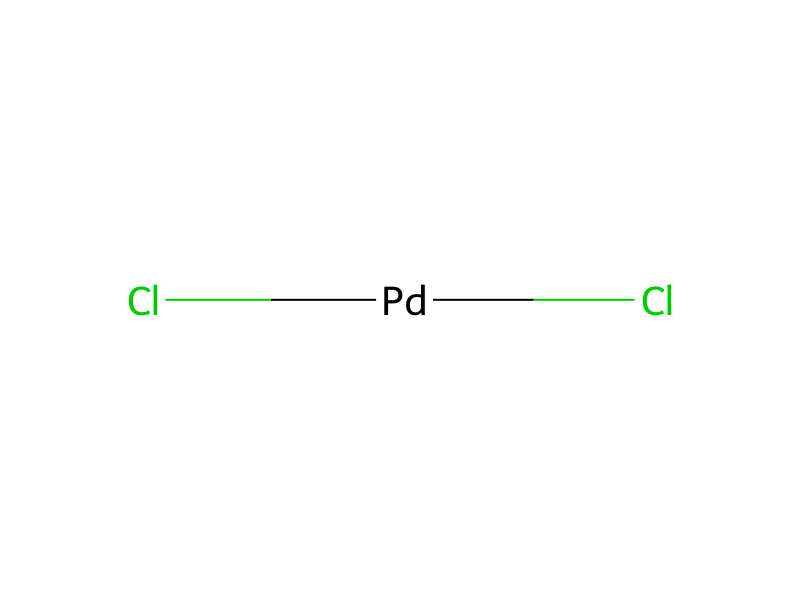
[Cl:1][C:2]1[N:7]=[C:6]([Cl:8])[C:5](I)=[CH:4][N:3]=1.C(N(CC)CC)C.C1(P(C2C=CC=CC=2)C2C=CC=CC=2)C=CC=CC=1.[CH3:36][Si:37]([C:40]#[CH:41])([CH3:39])[CH3:38]>C1COCC1.[Pd](Cl)Cl.[Cu](I)I>[Cl:1][C:2]1[N:7]=[C:6]([Cl:8])[C:5]([C:41]#[C:40][Si:37]([CH3:39])([CH3:38])[CH3:36])=[CH:4][N:3]=1Participants
8
Reactant 4




Product 1

Reagents, catalysts & solvents 3


Procedure
66.55 g of 2,4-dichloro-5-iodo-pyrimidine is stirred for three hous in 1.2 litres of absolute THF with 70 ml of triethylamine, 4.9 g of palladium chloride, 13.3 g of triphenylphosphine, 4 g of copper iodide and 39.3 ml of trimethylsilylacetylene at 40° C. After the reaction has ended the solvent is eliminated in vacuo and the dark red oil remaining is subjected to fractional distillation. The product is distilled over at 0.01 Torr and 100° C.
Workup
- distillationthe dark red oil remaining is subjected to fractional distillation
- distillationThe product is distilled over at 0.01 Torr and 100° C.
Sources & evidence
- ORD record
- ord-7824264cb5e34335a9bd42873718885b
- Source dataset
- uspto-grants-2007_02
- Patent number
- US07173028B2
Reaction notes
Loading…