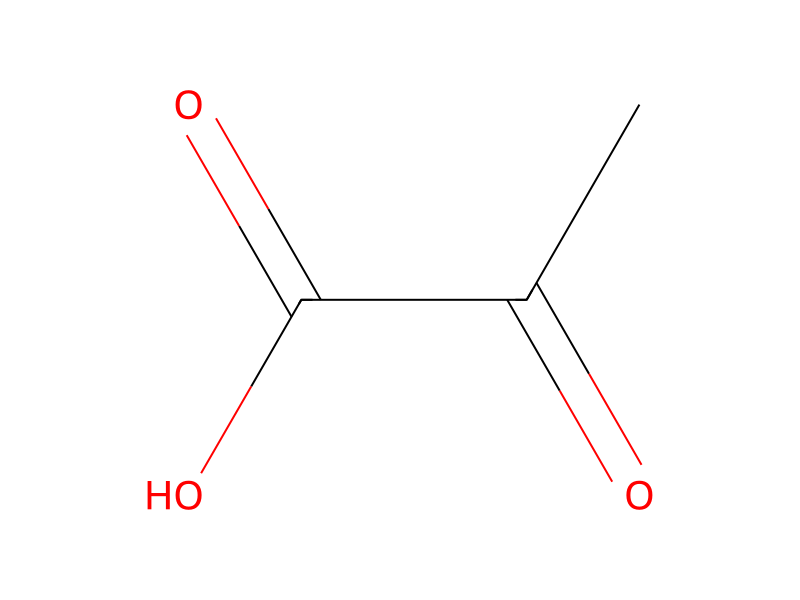
Pyruvic Acid → 5-(methoxycarbonyl)-1H-pyrrolo(3,2-b)pyridine-2-carboxylic acid
Reaction equation

[NH2:1][C:2]1[CH:3]=[CH:4][C:5]([C:8]([O:10][CH3:11])=[O:9])=[N:6][CH:7]=1.C1(P(C2C=CC=CC=2)C2C=CC=CC=2)C=CC=CC=1.[C:31]([OH:36])(=[O:35])[C:32]([CH3:34])=O.C(N(CC)CC)C>CN(C=O)C.C([O-])(=O)C.[Pd+2].C([O-])(=O)C>[CH3:11][O:10][C:8]([C:5]1[N:6]=[C:7]2[CH:34]=[C:32]([C:31]([OH:36])=[O:35])[NH:1][C:2]2=[CH:3][CH:4]=1)=[O:9]Participants
Reactant 4



Product 1

Reagents, catalysts & solvents 2


Conditions
- Temperature
- 100 °C
Procedure
Methyl 5-aminopyridine-2-carboxylate (1.2 g, 5.2 mmol) and triphenylphosphine (1.5 g, 5.7 mmol) were initially charged in 10 ml of DMF, and pyruvic acid (1.83 g, 20.8 mmol), palladium(II) acetate (279 mg, 1.2 mmol) and triethylamine (2.6 g, 26 mmol) were added. The reaction mixture was stirred at a temperature of 100° C. for four hours, then cooled, concentrated on a rotary evaporator and taken up in ethyl acetate, water was added and the mixture was shaken. The aqueous phase was concentrated on a rotary evaporator and then triturated with a little cyclohexane. This gave 0.5 g (38% of theory) of 5-(methoxycarbonyl)-1H-pyrrolo[3,2-b]pyridine-2-carboxylic acid. HPLC-MS: log P=0.44; mass (m/z): 221.0 (M+H)+; 1HNMR (D6-DMSO): δ 3.89 (s, 3H), 7.20 (s, 1H), 7.90-7.98 (m, 2H), 10 (broad, 1H), 12.24 (s, 1H).
Workup
- temperaturecooled
- concentrationconcentrated on a rotary evaporator
- additionwater was added
- stirringthe mixture was shaken
- concentrationThe aqueous phase was concentrated on a rotary evaporator
- customtriturated with a little cyclohexane
Sources & evidence
- ORD record
- ord-bc6851da7346401ba853887ee8b2972f
- Source dataset
- uspto-grants-2016_05
- Patent number
- US09345247B2
Reaction notes
Loading…