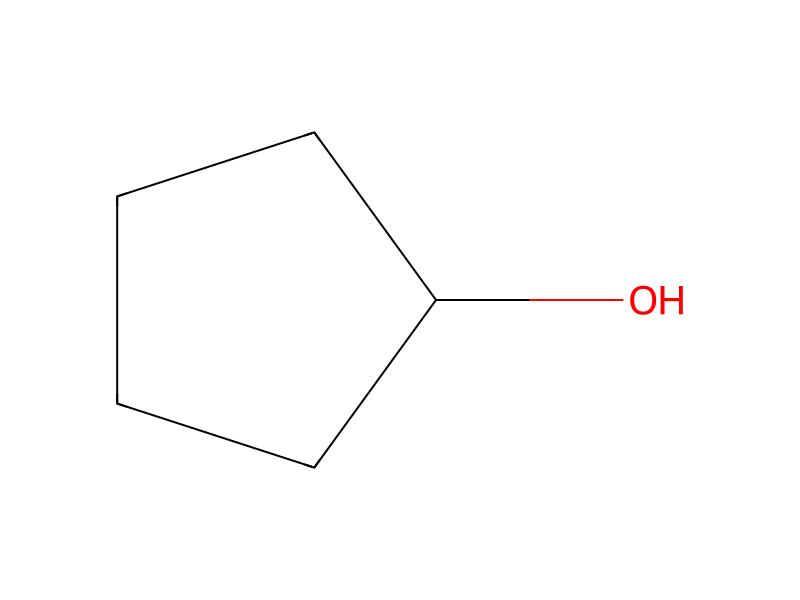
Cyclopentanol → 4-Bromo-1-(cyclopentyloxy)-2-nitrobenzene
Reaction equation

[Br:1][C:2]1[CH:7]=[CH:6][C:5]([OH:8])=[C:4]([N+:9]([O-:11])=[O:10])[CH:3]=1.[CH:12]1(O)[CH2:16][CH2:15][CH2:14][CH2:13]1.C1C=CC(P(C2C=CC=CC=2)C2C=CC=CC=2)=CC=1.CC(OC(/N=N/C(OC(C)C)=O)=O)C>C1COCC1>[Br:1][C:2]1[CH:7]=[CH:6][C:5]([O:8][CH:12]2[CH2:16][CH2:15][CH2:14][CH2:13]2)=[C:4]([N+:9]([O-:11])=[O:10])[CH:3]=1Participants
6





Procedure
To a mixture of 4-bromo-2-nitrophenol (1.0 g, 4.6 mmol), cyclopentanol (600 mg, 7.0 mmol) and Ph3P (1.47 g, 5.6 mmol) in THF (50 mL) at 0° C. was portion-wise added diisopropylazodicarboxylate (1.52 g, 7.5 mmol) in THF (10 mL) and the resulting mixture was left to stir overnight at ambient temperature. Solvent removal and purification by chromatography on silica gel afforded the sub-title compound (1.24 g, 94%).
Workup
- waitthe resulting mixture was left
- customSolvent removal and purification by chromatography on silica gel
Sources & evidence
- ORD record
- ord-61f2c25840554e998c3a381be422dfef
- Source dataset
- uspto-grants-2010_04
- Patent number
- US07705023B2
Reaction notes
Loading…