Diethylamine → 2-Methyl-7-((trimethylsilyl)ethynyl)quinoline
Reaction equation

Br[C:2]1[CH:11]=[C:10]2[C:5]([CH:6]=[CH:7][C:8]([CH3:12])=[N:9]2)=[CH:4][CH:3]=1.C1(P(C2C=CC=CC=2)C2C=CC=CC=2)C=CC=CC=1.C(NCC)C.[CH3:37][Si:38]([C:41]#[CH:42])([CH3:40])[CH3:39]>[Cu](I)I.CN(C=O)C>[CH3:12][C:8]1[CH:7]=[CH:6][C:5]2[C:10](=[CH:11][C:2]([C:42]#[C:41][Si:38]([CH3:40])([CH3:39])[CH3:37])=[CH:3][CH:4]=2)[N:9]=1Participants
7
Reactant 4




Product 1

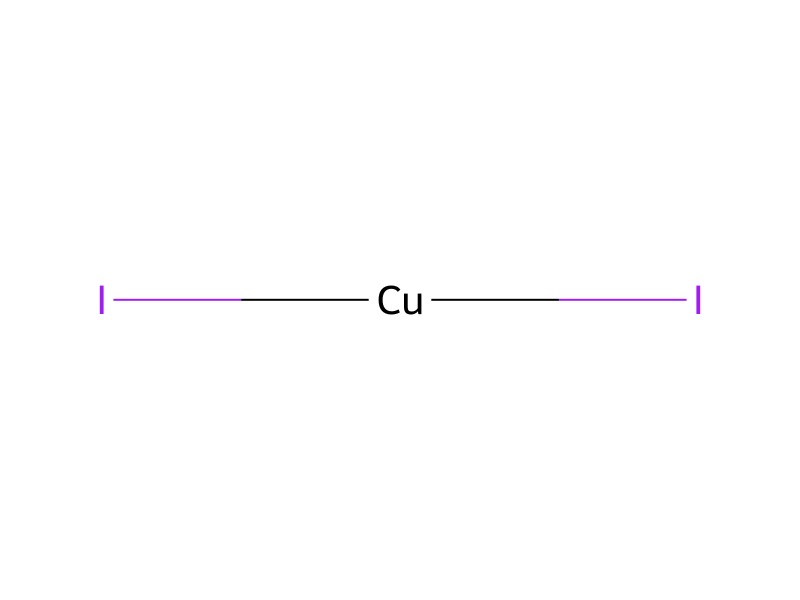
Reagents, catalysts & solvents 2

Conditions
- Temperature
- 110 °C
Procedure
In a sealed tube were introduced 7-bromo-2-methyl-quinoline (500 mg, 2.25 mmol, 1.0 eq), PdCl2(PPh3)3 (79 mg, 0.11 mmol, 5% mol), copper iodide (21 mg, 0.11 mmol, 5% mol), and triphenylphosphine (106 mg, 0.39 mmol, 20% mol). Then, DMF (5 mL) was added followed by diethylamine (3.5 mL, 34 mmol, 15 eq) and trimethylsilylacetylene (350 μL, 2.5 mmol, 1.1 eq). The mixture was heated at 110° C. overnight. After cooling down the solvent was evaporated and the crude product was purified by column chromatography (Florisil, Cyclohexane-EtOAc 95:5) to afford 2-methyl-7-trimethylsilanylethynyl-quinoline as a white solid (435 mg, 81%).
Workup
- temperatureAfter cooling down the solvent
- customwas evaporated
- customthe crude product was purified by column chromatography (Florisil, Cyclohexane-EtOAc 95:5)
Sources & evidence
- ORD record
- ord-7a011c6c5dae4ed2badb4c755c69e913
- Source dataset
- uspto-grants-2015_03
- Patent number
- US08993767B2
Reaction notes
Loading…