Diethylamine → 8-Cyanoquinoline
Reaction equation

Br[C:2]1[CH:3]=[C:4]2[C:9](=[C:10]([C:15]#[N:16])[C:11]=1N(C)C)[N:8]=[C:7](CO[Si](C(C)(C)C)(C)C)[CH:6]=[CH:5]2.C(NCC)C.C[Si](C#C)(C)C>[Cu](I)I.C1(P(C2C=CC=CC=2)C2C=CC=CC=2)C=CC=CC=1.CN(C=O)C>[N:8]1[C:9]2[C:4](=[CH:3][CH:2]=[CH:11][C:10]=2[C:15]#[N:16])[CH:5]=[CH:6][CH:7]=1Participants






Conditions
- Temperature
- 110 °C
Procedure
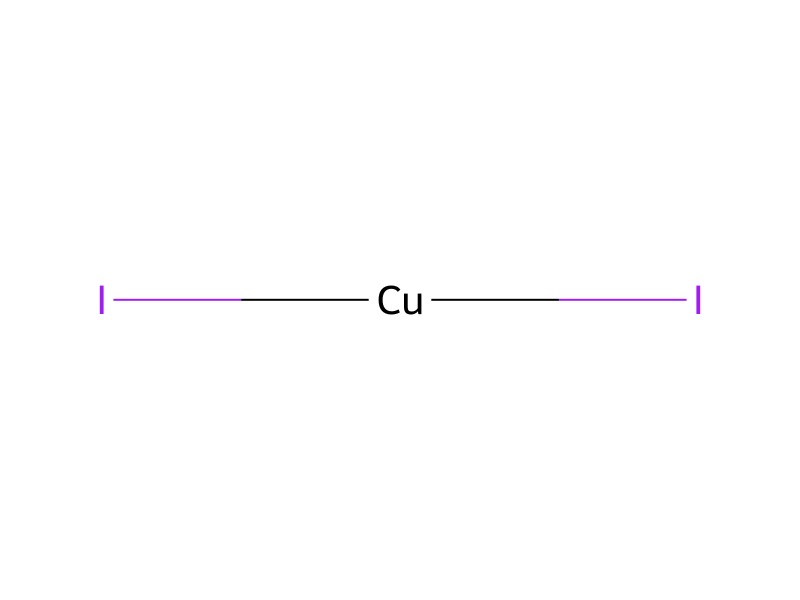
In a sealed tube were introduced the 6-bromo-2-((tert-butyldimethylsilyloxy)methyl)-7-(dimethylamino)quinoline-8-carbonitrile (946 mg, 2.25 mmol, 1.0 eq), PdCl2(PPh3)3 (79 mg, 0.11 mmol, 5% mol), copper iodide (21 mg, 0.11 mmol, 5% mol), and triphenylphosphine (106 mg, 0.39 mmol, 20% mol). Then, DMF (5 mL) was added followed by diethylamine (3.5 mL, 34 mmol, 15 eq) and trimethylsilylacetylene (350 μL, 2.5 mmol, 1.1 eq). The mixture was heated at 110° C. overnight. After cooling down the solvent was evaporated and the crude product was purified by column chromatography (Florisil, Cyclohexane-EtOAc 95:5) to afford 2-((tert-butyldimethylsilyloxy)methyl)-7-(dimethylamino)-6-(trimethylsilyl)ethynyl)quinoline-8-carbonitrile as a white solid (700 mg, 71%).
Workup
- temperatureAfter cooling down the solvent
- customwas evaporated
- customthe crude product was purified by column chromatography (Florisil, Cyclohexane-EtOAc 95:5)
Sources & evidence
- ORD record
- ord-029592c26bba4e4980d6114207b93988
- Source dataset
- uspto-grants-2015_03
- Patent number
- US08993767B2
Reaction notes
Loading…