Water → 7-Ethenyl-1H-indole
Reaction equation

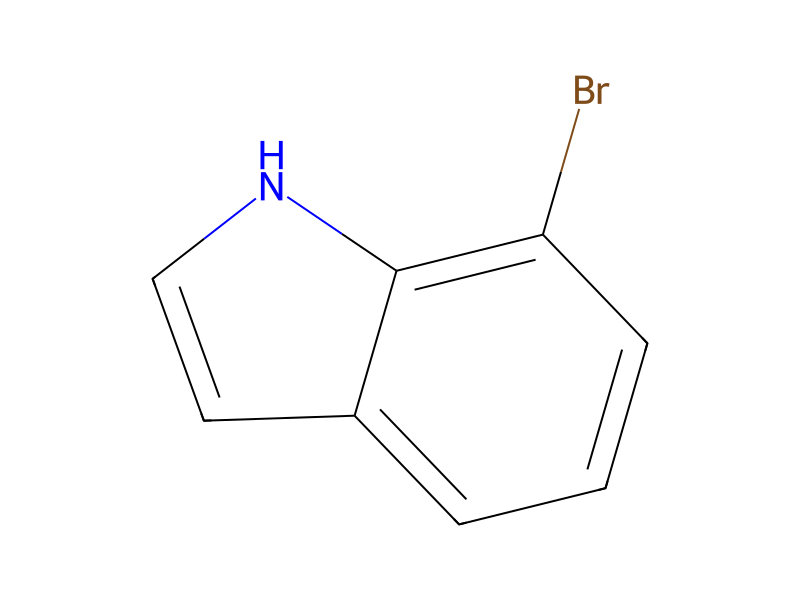
[CH2:1]([Sn](CCCC)(CCCC)C=C)[CH2:2]CC.[Cl-].[Li+].Br[C:19]1[CH:20]=[CH:21][CH:22]=[C:23]2[C:27]=1[NH:26][CH:25]=[CH:24]2.O>CN(C)C=O.C1([Pd-2](Cl)(Cl)C2C=CC=CC=2)C=CC=CC=1.C1(P(C2C=CC=CC=2)C2C=CC=CC=2)C=CC=CC=1.C(OCC)(=O)C>[CH:1]([C:19]1[CH:20]=[CH:21][CH:22]=[C:23]2[C:27]=1[NH:26][CH:25]=[CH:24]2)=[CH2:2]Participants
Reactant 4



Product 1

Reagents, catalysts & solvents 4




Conditions
- Temperature
- 100 °C
Procedure
Add-tributyl(vinyl)tin (9.8 mL, 33.7 mmol), triphenyl-phosphine (0.4 g, 1.53 mmol), diphenylpalladium(II) dichloride (1.07 g, 1.53 mmol) and lithium chloride (4.0 g, 94.4 mmol) to 7-bromo-1H-indole (6.0 g, 30.6 mmol) in 150 mL of dimethylformamide and heat the resulting mixture at 100° C. overnight. Cool the reaction mixture to 20-24° C. and poured into a mixture of 150 mL of water and 150 mL of ethyl acetate. Wash the aqueous layer with additional ethyl acetate (3×100 mL), combine the organic layers, wash with saturated aqueous sodium chloride, dry over magnesium sulfate, filter, and concentrate under reduced pressure. Subject the residue to silica gel chromatography, eluting with 5-10% ethyl acetate in hexanes. Combine fractions containing product and concentrate them under reduced pressure to provide the desired compound as a clear oil (3.5 g, 80%).
Workup
- temperatureCool the reaction mixture to 20-24° C.
- washWash the aqueous layer with additional ethyl acetate (3×100 mL)
- washwash with saturated aqueous sodium chloride
- dry with materialdry over magnesium sulfate
- filtrationfilter
- concentrationconcentrate under reduced pressure
- washeluting with 5-10% ethyl acetate in hexanes
- additionCombine fractions containing product
- concentrationconcentrate them under reduced pressure
Sources & evidence
- ORD record
- ord-f956cce919854dba9fea3f949893433e
- Source dataset
- uspto-grants-2011_09
- Patent number
- US08022065B2
Reaction notes
Loading…