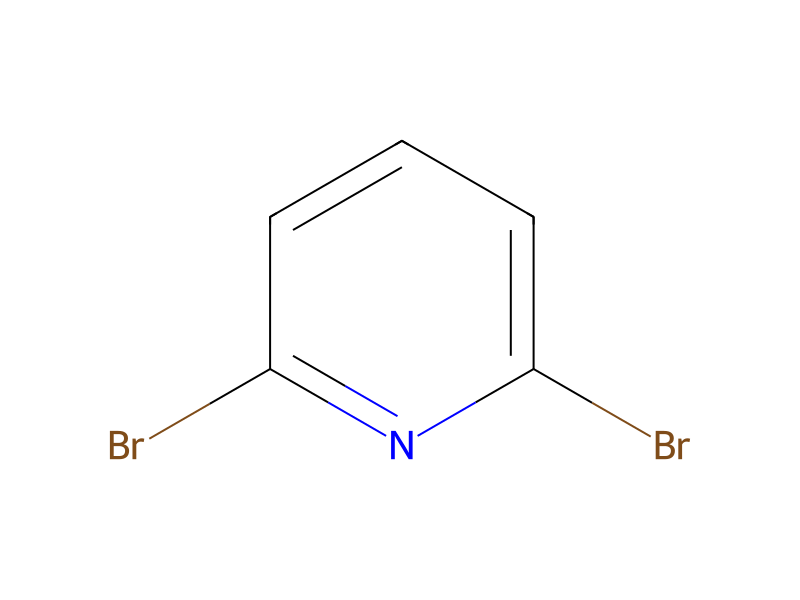
A suspension of 2,6-dibromopyridine (11.13 g, 47.0 mmol), pivalic acid (0.545 mL, 4.70 mmol), potassium carbonate (6.49 g, 47.0 mmol) in N,N-dimethylacetamide (45 mL) was deoxygenated by bubbling argon through it for 20 minutes. Thiazole (1.681 mL, 23.49 mmol) and tetrakis(triphenylphosphine)palladium(0) (1.086 g, 0.940 mmol) were added, the flask was sealed, and the reaction mixture was heated to 115° C. for 18 hours. The reaction mixture was cooled to room temperature and then diluted with water (50 mL), ethyl acetate (50 mL), and diethyl ether (50 mL). The layers were separated and then the organic layer was washed with water (2×50 mL), saturated aqueous sodium bicarbonate solution (25 mL), and brine (50 mL) The organic layer was dried over sodium sulfate, filtered, and concentrated under reduced pressure. The residue was purified by chromatography on silica gel (10-60% ethyl acetate/hexanes) to provide 2-bromo-6-(1,3-thiazol-5-yl)pyridine. MS ESI calc'd. for C8H5BrN2S [M+H]+ 241 and 243. found 241 and 243. 1H NMR (500 MHz, DMSO-d6) δ 9.19 (s, 1H), 8.64 (s, 1H), 8.06 (d, J=7.6 Hz, 1H), 7.83 (t, J=7.8 Hz, 1H), 7.58 (d, J=7.8 Hz, 1H).